
Last reviewed: May 2026 | Community resource — not medical advice. Always consult a dermatologist who is familiar with HS before starting, changing, or stopping any treatment.
Antibiotics are almost always the first treatment prescribed when someone is diagnosed with Hidradenitis Suppurativa. They’re familiar to doctors, widely available, and relatively affordable. But after weeks or months on antibiotics, many HS patients find themselves asking the same questions: Is this actually working? Should I still be taking these? Why did my doctor prescribe this particular one? And when does it make sense to move on to something else?
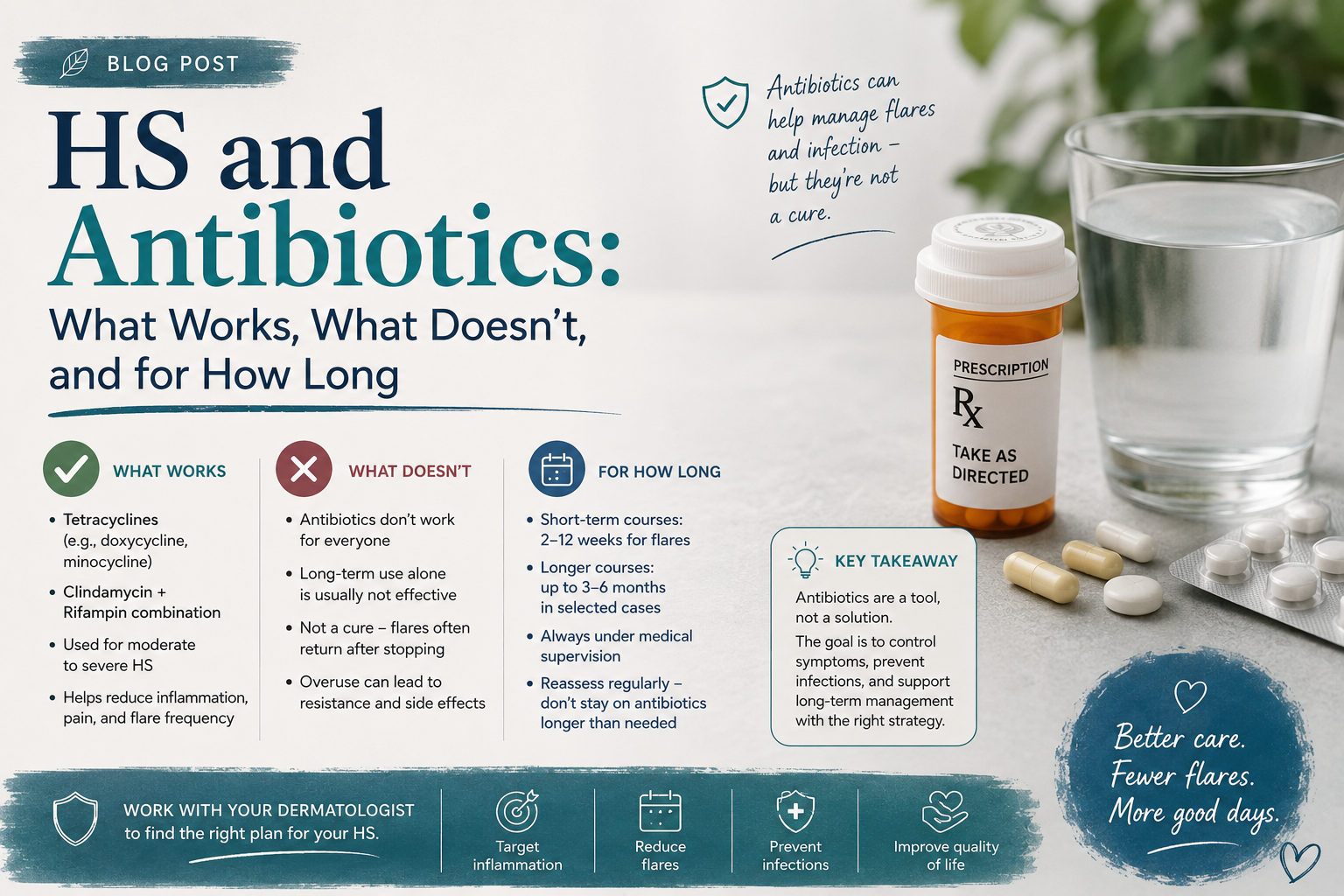
This guide answers all of those questions — and does it honestly. Antibiotics do have a real role in HS management, but their limitations are just as important to understand as their benefits.
Why Antibiotics Are Used for HS at All — It’s Not What You Think
Here’s something that surprises many newly diagnosed patients: antibiotics don’t primarily work in HS because HS is an infection. It isn’t. HS is a chronic inflammatory disease — driven by follicular occlusion and a dysregulated immune response — not by bacteria invading from outside.
So why antibiotics? Because several classes of antibiotics — particularly tetracyclines and macrolides — have significant anti-inflammatory and immunomodulatory properties completely separate from their antibacterial effects. They suppress the inflammatory cytokines that drive HS lesion formation. The antibacterial effect is secondary — it helps manage bacterial colonisation of lesions and reduces secondary infection risk, but it’s the anti-inflammatory action that makes antibiotics useful in HS.
This distinction matters, because it explains:
- Why antibiotics can help even when HS lesions aren’t “infected”
- Why antibiotic resistance is a growing concern even if bacteria aren’t the root cause
- Why antibiotics tend to work better in milder disease, where inflammation is less entrenched
- Why antibiotics alone are rarely enough for moderate-to-severe HS
The 2025 European S2k guidelines for HS, published in the Journal of the European Academy of Dermatology and Venereology by Zouboulis et al., confirm that antibiotics are recommended as first-line treatment primarily for their anti-inflammatory activity, not their antimicrobial effects.
📚 Reference: Zouboulis CC et al. “European S2k guidelines for hidradenitis suppurativa/acne inversa part 2: Treatment.” JEADV, 2025. Read on Wiley
The HS Antibiotic Ladder: From Topical to IV
Think of antibiotics for HS as a ladder — you start at the bottom (topical, local, gentle) and move up (systemic, combination, hospital-grade) as disease severity and treatment need increase. Here’s the full picture, rung by rung.
Rung 1: Topical Clindamycin 1%
What it is: A gel or lotion applied directly to affected skin, usually twice daily.
Who it’s for: Stage I (mild) HS, or as an adjunct to systemic treatment in more severe disease. Also sometimes used during pregnancy, when systemic options are more limited.
How it works: Topical clindamycin reduces superficial bacterial colonisation and delivers a local anti-inflammatory effect. It is the only topical antibiotic with well-documented evidence in HS, validated in a double-blind, placebo-controlled randomised trial.
The honest limitations: Topical clindamycin works on the surface. It does not reach deep nodules, abscesses, or sinus tracts. If your lesions are below the skin surface — which is the case in most HS — topical treatment alone will not be enough. Guidelines are explicit: topical clindamycin should not be relied upon as the sole treatment for Hurley Stage II disease with active abscesses.
Antibiotic resistance concern: Prolonged use of topical clindamycin alone promotes resistance in skin bacteria. To reduce this risk, the current best practice is to combine topical clindamycin with a benzoyl peroxide wash (2.5–5%) — the benzoyl peroxide reduces the likelihood of resistant strains developing. Alternatively, a clindamycin–benzoyl peroxide fixed combination gel is available in some countries.
📚 Reference: “Topical Treatments for Hidradenitis Suppurativa.” Practical Dermatology, 2026. Read here
Rung 2: Oral Tetracyclines (Doxycycline, Lymecycline, Minocycline)
What they are: Broad-spectrum oral antibiotics taken once or twice daily.
Who they’re for: Mild-to-moderate HS (Hurley Stage I–II), as first-line oral antibiotic therapy. Also used for long-term maintenance in patients whose disease stabilises on tetracyclines.
How they work: Tetracyclines bind to the 30S ribosomal subunit in bacteria, inhibiting protein synthesis. But more importantly for HS, they suppress NF-kB signalling and reduce production of inflammatory cytokines including TNF-α, IL-1, and IL-6.
The evidence: The largest study to date comparing tetracyclines to other antibiotics in HS is a prospective, multicentre cohort study of 283 patients (van Straalen et al.), cited extensively in the 2025 European guidelines. It found that tetracyclines showed similar efficacy to the rifampicin–clindamycin combination across disease severities — a finding that has significantly influenced current prescribing.
Specific numbers: approximately 60–64% of patients achieved HiSCR (at least 50% reduction in inflammatory lesions) after 12 weeks of doxycycline 100 mg twice daily, comparable to the modified-release 40 mg/day formulation, which had a similar response rate with potentially fewer side effects.
Standard duration: 3 months (12 weeks), per both European and North American guidelines. Tetracyclines should not be used in pregnant women or children under 9 years due to risk of permanent tooth discolouration.
Common side effects: Sun sensitivity (use SPF daily), nausea (take with food), oesophageal irritation (always take with a full glass of water, don’t lie down for 30 minutes after), and occasional yeast infections.
What the community says: Many patients find doxycycline helpful for calming active flares, but notice it stops being effective after a few months. This is a well-recognised pattern — tetracyclines are not a long-term solution for progressive HS.
“Doxycycline helped me for about 4 months, then my skin just stopped responding. My derm switched me to the rifampicin combination and that worked better.” — HS Warriors member
Rung 3: Rifampicin + Clindamycin Combination (Oral)
What it is: Two oral antibiotics taken together — rifampicin (typically 300 mg twice daily or 600 mg once daily) and clindamycin (300 mg twice daily) — for a defined course of 10–12 weeks.
Who it’s for: Moderate HS (Hurley Stage II) that has not responded adequately to tetracyclines, or as first-line combination therapy in more active disease. Also used before initiating biologics as a mandatory trial of conventional therapy in many healthcare systems.
How it works: Rifampicin inhibits bacterial RNA polymerase — it is a powerful antibiotic normally associated with tuberculosis treatment. Clindamycin inhibits protein synthesis. Together, they cover a broader range of the bacteria commonly found in HS lesions (Staphylococcus aureus, coagulase-negative staphylococci, anaerobes) while also having complementary anti-inflammatory effects.
Crucially, rifampicin must never be used as monotherapy in HS — used alone, it leads to rapid bacterial resistance. The combination prevents resistance development in both drugs.
The evidence: A 2025 literature review published in Clinical and Experimental Dermatology by Wainman, Hutchison, and Ingram — searching 954 articles — confirmed that rifampicin–clindamycin combination remains recommended across global HS guidelines as a step-up from tetracyclines. The 2025 European S2k guidelines similarly affirm its position as a standard second-line antibiotic regimen.
An important nuance from the recent literature: the combination does not appear significantly more effective than tetracyclines in terms of HiSCR rates. The van Straalen cohort study found comparable efficacy between the two approaches. What the combination does offer is a different mechanism, making it useful when tetracyclines have failed.
📚 Reference: Wainman HE et al. “Is there still a role for clindamycin and rifampicin in the treatment of hidradenitis suppurativa?” Clinical and Experimental Dermatology, August 2025. Read on Oxford Academic
Side effects to know about:
- Rifampicin turns body fluids (urine, sweat, tears) orange-red — this is harmless but alarming if unexpected
- Rifampicin is a potent inducer of liver enzymes (CYP450), which means it significantly reduces the effectiveness of many other medications including hormonal contraception. If you are using the pill, patch, or ring for contraception, you must use barrier contraception during and for 8 weeks after a rifampicin course
- Clindamycin at oral doses carries a small risk of Clostridioides difficile (C. diff) colitis — contact your doctor immediately if you develop severe, persistent diarrhoea
- Liver function should ideally be monitored during a course of rifampicin
Duration and what happens after: The standard course is 10–12 weeks. After completing the course, some patients maintain response for months; others relapse relatively quickly. If there has been no meaningful response by week 12, continuing the same combination is not supported by evidence — at this point, escalation to biologic therapy should be discussed.
Rung 4: Triple Antibiotic Therapy — Rifampicin + Moxifloxacin + Metronidazole (RMoM)
What it is: A three-antibiotic oral regimen used for moderate-to-severe disease that has not responded to the two-drug combinations above.
Who it’s for: Patients with more severe or refractory HS, typically as a second-line combination or a bridge to surgery/biologics. Recommended in both US/Canadian HS Foundation guidelines and European guidelines for moderate-to-severe disease as second- or third-line treatment.
How it works: This regimen is based on microbiome studies of HS lesions showing significant anaerobic bacterial involvement. Metronidazole specifically targets anaerobes; moxifloxacin covers a broad gram-positive and gram-negative spectrum; rifampicin prevents resistance.
The evidence: A prospective cohort study by Join-Lambert et al. of 28 consecutive patients showed significant reduction in Sartorius scores after 12 weeks, with some patients achieving complete remission. The regimen was studied as rifampicin (10 mg/kg once daily) + moxifloxacin (400 mg once daily) + metronidazole (250–500 mg three times daily) for the first 6 weeks, then rifampicin + moxifloxacin for a further 4 weeks, then cotrimoxazole for maintenance.
Important: Metronidazole is stopped at week 6 to avoid peripheral neuropathy (nerve damage) from prolonged use. This is not optional — it is a safety requirement.
Side effects are more significant at this level: Moxifloxacin carries a small risk of tendon damage (particularly Achilles tendon) and QT interval prolongation affecting heart rhythm. It should not be used in patients with known cardiac arrhythmias or those on other QT-prolonging medications. The combination requires more monitoring than simpler regimens.
📚 Reference: Medscape eMedicine. “HS Guidelines: USHSF/CHSF and European Guidelines.” Read here
Rung 5: Intravenous Ertapenem (Hospital-Grade Rescue)
What it is: A carbapenem-class intravenous antibiotic, given daily for 6 weeks, typically in a hospital or specialist outpatient setting.
Who it’s for: Severe, refractory HS that has failed multiple antibiotic regimens and biologics — used as a “rescue” therapy or bridge to surgery or a new biologic. This is not a standard treatment — it’s a last resort before surgery when other options have been exhausted.
The evidence: The most-cited study is by Join-Lambert et al., who demonstrated significant efficacy in 30 consecutive severe HS patients using IV ertapenem (1 g daily for 6 weeks) followed by consolidation with the triple RMoM oral regimen. A 2023 study published in the Journal of Dermatological Treatment confirmed these findings in a real-world cohort — median disease severity scores dropped significantly and pain VAS scores fell from 9/10 to 2/10.
📚 Reference: “Intramuscular ertapenem for the treatment of severe hidradenitis suppurativa.” Journal of Dermatological Treatment, 2023. Read on Taylor & Francis
Antibiotics That Don’t Work Well in HS
Not every antibiotic that a doctor might reach for is appropriate for HS. Based on current evidence and guidelines:
Isotretinoin (Roaccutane/Accutane): Often tried because it’s associated with acne, which HS can resemble. The evidence for HS specifically is poor. Guidelines explicitly state: do not offer isotretinoin for HS unless there are concomitant moderate-to-severe acneiform lesions on the face or trunk. It will not treat classic HS lesions.
Doxycycline or tetracycline monotherapy for Stage II with abscesses: As noted in current evidence summaries, tetracycline monotherapy achieves only around 30% abscess reduction in Stage II disease — too low to justify its use as the primary treatment when active abscesses are present.
Etanercept (a biologic TNF inhibitor used in psoriasis): Trials have shown it to be ineffective in HS. Do not accept a prescription for etanercept for HS — it is not the right biologic for this disease.
Long-term continuous antibiotics without breaks: Ongoing antibiotic use creates resistance risk without proportionate benefit. Current guidelines advise against using antibiotics indefinitely — they are for defined courses, with reassessment and escalation if not working.
The Antibiotic Resistance Problem in HS
Antibiotic resistance is a growing concern in HS management — and it matters both for individual patients and for public health.
HS lesions are commonly colonised by Staphylococcus aureus, coagulase-negative staphylococci, and various anaerobic bacteria. Prolonged antibiotic exposure — especially with topical clindamycin used alone — can select for resistant strains. Once resistant strains are established, the same antibiotic will no longer be effective.
Research published in the British Journal of Dermatology specifically flagged antibiotic resistance in HS lesions as a growing problem, noting that “the emergence of resistant bacterial strains in HS lesions has been reported.”
Practically, this means:
- Always combine topical clindamycin with benzoyl peroxide wash to reduce resistance risk
- Complete antibiotic courses as prescribed rather than stopping early and restarting repeatedly
- Don’t request antibiotics indefinitely “just in case” — work with your doctor on a structured plan
- If you’ve had multiple antibiotic courses and your HS is not improving, this is a strong signal to escalate to biological therapy rather than cycling through more antibiotics
When Antibiotics Are No Longer the Answer
One of the most important decisions in HS management is recognising when antibiotics have reached their limit — and being willing to have that conversation with your doctor.
Current evidence-based guidance is clear: if there has been no meaningful clinical response after 12 weeks of rifampicin–clindamycin, the next step should be escalation to adalimumab or another approved biologic — not continuing antibiotics indefinitely.
Signs that it may be time to discuss moving beyond antibiotics:
- You’ve completed two or more 12-week antibiotic courses with limited or diminishing response
- Your disease has progressed from Stage I to Stage II, or Stage II toward Stage III, while on antibiotics
- You’re developing sinus tracts (tunnels) — a sign that inflammation is becoming entrenched and structural damage is occurring
- Your quality of life continues to be significantly affected despite antibiotic treatment
If your dermatologist continues to prescribe antibiotics cycle after cycle without reassessing your treatment plan, it is completely appropriate to ask: “At what point would you consider escalating to biologic therapy, and what criteria would we use to make that decision?”
A Note on Antibiotics Before and Alongside Biologics
One nuance worth knowing: antibiotics and biologics aren’t always either/or. Research published in the Journal of the European Academy of Dermatology and Venereology in 2024 found that initiating adalimumab together with a clindamycin–rifampicin course improved clinical effectiveness compared to adalimumab alone. Some clinicians use a brief antibiotic bridge when starting a biologic, particularly if there is active acute inflammation.
Similarly, topical clindamycin can be continued alongside systemic biologic therapy to manage localised surface lesions — they work at different levels and can complement each other.
Antibiotics in Special Populations
Pregnancy: Treatment options narrow significantly during pregnancy. Topical clindamycin is generally considered the safest antibiotic option. Rifampicin and short-term doxycycline may be considered in specific circumstances based on limited data and expert opinion, but should only be used after careful discussion with a dermatologist and obstetrician. Tetracyclines (including doxycycline) are contraindicated in the second and third trimesters and in breastfeeding due to risks to the baby’s tooth and bone development.
📚 Reference: “North American clinical practice guidelines for the medical management of hidradenitis suppurativa in special patient populations.” JAAD, 2025. Read here
Children and adolescents: Tetracyclines are contraindicated in children under 9 years. Management in this group is more limited and should involve a paediatric dermatologist.
People on hormonal contraception: Rifampicin significantly reduces the efficacy of hormonal contraception (pill, patch, ring, implant). Additional barrier contraception is essential during treatment and for 8 weeks after finishing a rifampicin course.
Practical Summary: Antibiotic Options at a Glance
| Treatment | Stage | Duration | Key caveat |
|---|---|---|---|
| Topical clindamycin 1% | Stage I | Ongoing, with BP wash | Surface only; doesn’t reach deep lesions |
| Doxycycline 100mg twice daily | Stage I–II | 12 weeks | Not for pregnancy; sun sensitivity |
| Rifampicin + clindamycin (oral) | Stage II | 10–12 weeks | Turns fluids orange; check contraception |
| Rifampicin + moxifloxacin + metronidazole | Stage II–III | 12 weeks (stop metronidazole at 6 weeks) | More side effects; cardiac monitoring |
| IV ertapenem | Stage III (rescue) | 6 weeks, hospital setting | Last resort before surgery |
Talking to Your Doctor
If you’re currently on antibiotics for HS and wondering whether they’re the right approach, here are some questions worth raising at your next appointment:
- “What specific antibiotic are you prescribing, and why this one for my stage of HS?”
- “How long should I take this before we assess whether it’s working?”
- “If this doesn’t achieve a response, what’s the next step?”
- “Am I a candidate for biologic therapy, and what would I need to demonstrate for that to be considered?”
You deserve a clear, structured treatment plan — not an indefinite cycle of prescriptions without a defined endpoint.
The HS Warriors Community
Have you been through antibiotic treatment for HS? What worked, what didn’t, and how did you navigate the conversation with your dermatologist about escalating treatment? Your experience could be exactly what someone newly diagnosed needs to hear.
👉 Join the medical treatment discussion 👉 Find a dermatologist by region 👉 Register to share your story
This article is for informational purposes only and does not constitute medical advice. Always consult a qualified healthcare provider before starting, changing, or stopping any medication.
Sources & Further Reading:
- Zouboulis CC et al. “European S2k guidelines for HS/acne inversa part 2: Treatment.” JEADV, 2025. Wiley
- Wainman HE et al. “Is there still a role for clindamycin and rifampicin in HS?” Clinical and Experimental Dermatology, 2025. Oxford Academic
- “North American clinical practice guidelines for HS in special patient populations.” JAAD, 2025. JAAD
- “HS Guidelines: USHSF/CHSF and European Guidelines.” Medscape eMedicine. Medscape
- “Intramuscular ertapenem for severe HS.” Journal of Dermatological Treatment, 2023. Taylor & Francis
- “Topical Treatments for Hidradenitis Suppurativa.” Practical Dermatology, 2026. Read here
- American Academy of Dermatology. “HS Clinical Guidelines.” AAD.org
- HS Foundation. Resources and provider directory. hs-foundation.org
- National Institutes of Health — PubMed HS research. PubMed