
Last reviewed: May 2026 | Community resource — not medical advice. Always discuss treatment decisions with a dermatologist experienced in HS.
If you have moderate-to-severe Hidradenitis Suppurativa and your doctor has mentioned Humira, or if you’re researching your options before your next appointment, this guide is for you.
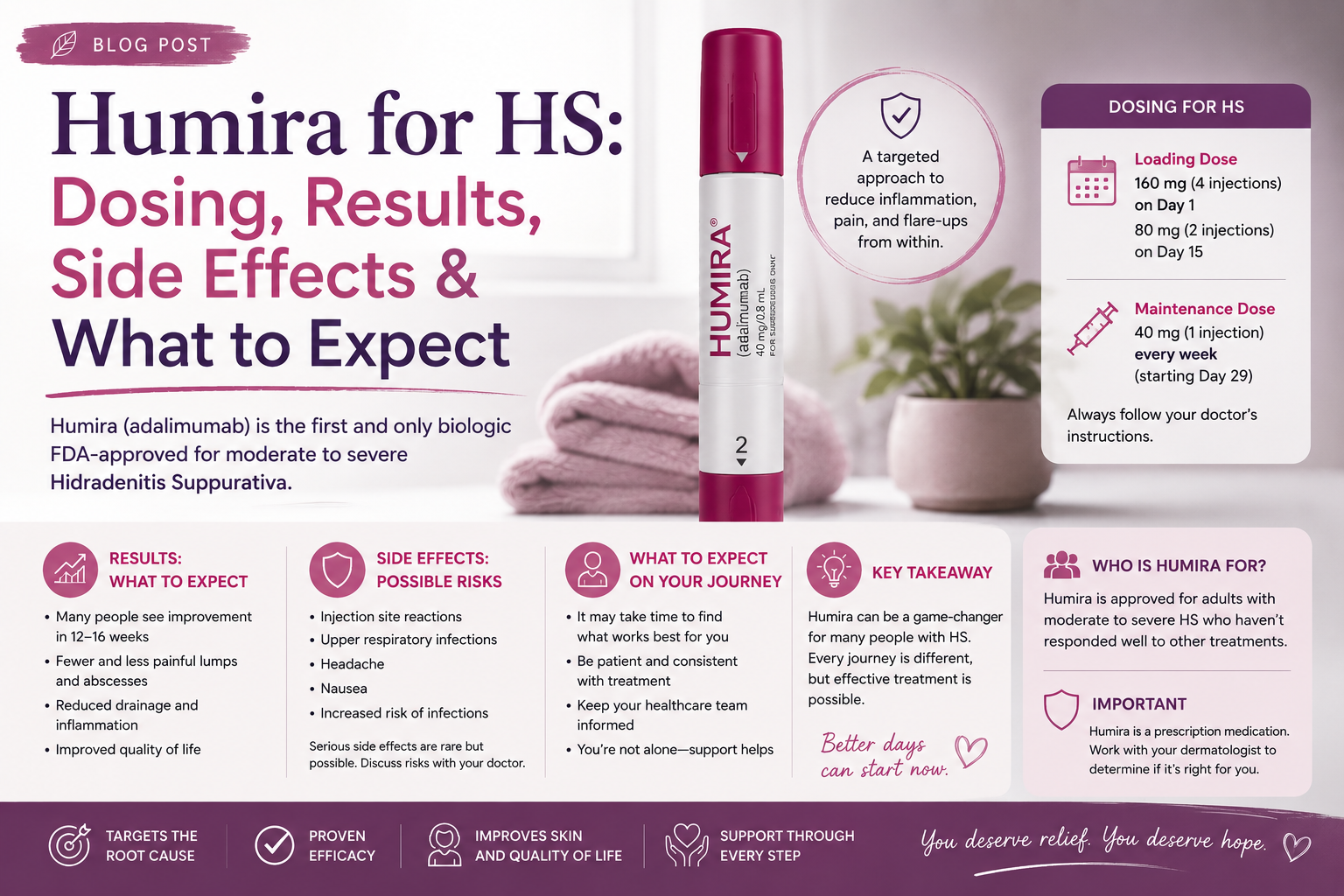
Adalimumab — sold under the brand name Humira, and now available as multiple biosimilars — was the first biologic medication ever approved specifically for HS, receiving FDA approval in 2015. For nearly a decade it was the only approved biologic for the disease. Even now that newer biologics exist, adalimumab remains the most prescribed biologic for HS worldwide, the most studied, and the one with the longest real-world safety record.
This article explains how it works, what the clinical trials actually showed, what side effects to watch for, how to inject it, what makes some patients respond better than others, what biosimilars are and whether they work the same, and how to know when it might be time to consider alternatives.
What Is Adalimumab (Humira) and How Does It Work in HS?
Adalimumab is a fully human monoclonal antibody — a lab-engineered protein that precisely targets and neutralises TNF-α (Tumor Necrosis Factor alpha), one of the primary inflammatory signalling proteins driving HS disease activity.
In healthy immune function, TNF-α plays an important role in fighting infection. In HS, TNF-α is chronically overproduced in affected skin tissue, driving the inflammatory cascade that creates nodules, abscesses, and sinus tracts. By binding to both soluble TNF-α (circulating in the blood) and membrane-bound TNF-α (on cell surfaces), adalimumab blocks this signal before it can amplify inflammation.
The result, for many patients, is a significant reduction in the number of new abscesses and inflammatory nodules, less pain, and — over time — slower disease progression.
It’s important to understand what adalimumab does not do: it does not eliminate existing sinus tracts, reverse established scarring, or cure HS. It suppresses the inflammatory process that drives new lesion formation. This is why it works best when started before extensive structural damage has occurred.
Who Is Adalimumab Approved For?
Adalimumab is FDA-approved (US), EMA-approved (Europe), and approved by regulatory agencies in most countries for moderate-to-severe HS in adults who have had an inadequate response to conventional systemic therapy — meaning antibiotic treatment has been tried and has not achieved sufficient control.
In most healthcare systems, your dermatologist will need to document:
- A confirmed diagnosis of HS at Hurley Stage II or III
- A documented trial of systemic antibiotics (typically at least 3 months of rifampicin–clindamycin or tetracyclines) that failed to achieve adequate response
- Absence of contraindications (see below)
Adalimumab is also approved for HS in adolescents aged 12 and over in some countries including the US and EU, making it one of the few HS biologics with a paediatric indication.
The PIONEER Trials: What the Evidence Actually Shows
Adalimumab’s approval was based on two large Phase 3 clinical trials: PIONEER I and PIONEER II, both published in the New England Journal of Medicine in 2016 by Kimball et al. These are the cornerstone evidence base for adalimumab in HS.
Study design: Both trials enrolled patients with moderate-to-severe HS. Patients were randomised 1:1 to adalimumab 40 mg weekly or placebo for 12 weeks (Period A), then reassigned to different dose regimens for a further 24 weeks (Period B).
Primary outcome: HiSCR at week 12 — defined as at least a 50% reduction in inflammatory lesion count (abscesses + nodules) with no increase in abscesses or draining tunnels.
Results at week 12:
| Trial | Adalimumab (weekly) | Placebo | Difference |
|---|---|---|---|
| PIONEER I | 41.8% achieved HiSCR | 26.0% | +15.8% |
| PIONEER II | 58.9% achieved HiSCR | 27.6% | +31.3% |
Both results were statistically significant. PIONEER II showed a particularly strong effect, likely reflecting differences in patient populations and background antibiotic use between the trials.
What do these numbers mean in plain terms?
Roughly 42–59% of patients on weekly adalimumab achieved a meaningful clinical response by week 12, compared to 26–28% on placebo. The placebo response is real and worth noting — skin conditions have consistently significant placebo effects in trials. The net benefit of adalimumab over placebo was approximately 16–31 percentage points.
Put another way: if you start adalimumab, there is roughly a 4-in-10 to 6-in-10 chance of achieving a significant improvement at 3 months. For a disease that has often been poorly controlled for years, that is meaningful — though it also means that a significant proportion of patients do not respond, which is important to understand going in.
📚 Reference: Kimball AB et al. “Two Phase 3 Trials of Adalimumab for Hidradenitis Suppurativa.” New England Journal of Medicine, 2016. Read on NEJM
Long-Term Results: Does It Keep Working?
The PIONEER trials included a 3-year open-label extension (OLE) study, providing the longest controlled dataset available for any HS biologic.
Key findings from the OLE, published in the Journal of the American Academy of Dermatology:
- Among patients who received weekly adalimumab continuously throughout the trials, 52.3% maintained HiSCR at week 168 (approximately 3 years)
- Among patients who were “responders and partial responders” at earlier timepoints, 57.1% maintained response at week 168
- Weekly dosing consistently outperformed every-other-week dosing as a maintenance strategy
An important caveat from the 3-year data: at least 16% of initial responders developed secondary loss of response within 3 years. Loss of response over time is a real phenomenon with adalimumab — it’s not permanent for everyone.
Separately, a prospective observational study on therapeutic drug monitoring published in 2024 found that nearly half of patients on standard adalimumab dosing eventually lose response, and that serum adalimumab levels correlate with response — patients with lower drug concentrations tend to lose efficacy.
📚 Reference: Kimball AB et al. “Long-term adalimumab efficacy in patients with moderate-to-severe HS: 3-year results of a phase 3 open-label extension study.” JAAD, 2018. Read on ScienceDirect
Dosing: The Standard Regimen
The FDA-approved dosing schedule for adalimumab in HS is specific and different from the dosing used for other conditions like rheumatoid arthritis or psoriasis:
Week 0 (Day 1): 160 mg — given as four 40 mg injections on the same day, or two injections per day over two consecutive days Week 2 (Day 15): 80 mg — given as two 40 mg injections Week 4 onward: 40 mg every week — one injection weekly, continuing indefinitely
This loading dose schedule is designed to reach therapeutic drug levels quickly. The every-week maintenance dosing for HS is more frequent than the every-other-week schedule used for many other adalimumab indications — this reflects that HS requires higher sustained drug levels to maintain response.
The PIONEER data is clear on one point: weekly dosing is significantly more effective than every-other-week dosing for HS maintenance. Patients whose dosing was reduced to every other week during the trials lost response at much higher rates. If your doctor tries to reduce your frequency to save money or simplify the regimen, this is worth discussing — the evidence supports staying weekly.
How to Inject Adalimumab
Adalimumab is a subcutaneous injection — injected into the fatty tissue just beneath the skin. It comes as:
- A prefilled autoinjector pen (most common — click the pen against the skin, press the button)
- A prefilled syringe (for those who prefer manual control or need lower concentrations)
Injection sites: Rotate between the front of the thighs, the abdomen (at least 5 cm from the navel), and the upper outer arm. Avoid skin that is bruised, tender, red, hard, or affected by HS lesions. Never inject into HS-affected areas.
Storage: Refrigerate at 2–8°C. Can be kept at room temperature (up to 25°C) for up to 14 days if needed. Never freeze. Allow the pen or syringe to reach room temperature for 15–30 minutes before injecting — this significantly reduces injection-site discomfort.
Injection site reactions (redness, swelling, itching, bruising at the injection site) are common — occurring in approximately 20% of patients — but usually mild and temporary. They typically improve over the first few months of treatment. High-concentration, citrate-free formulations (available in some biosimilars and in the Humira high-concentration formulation) tend to be less painful to inject.
Side Effects: What to Know Before You Start
Adalimumab is an immunosuppressant. Understanding its side effect profile helps you make an informed decision and know when to seek medical attention.
Common side effects (more than 10% of patients)
- Infections of the upper respiratory tract — colds, sinusitis, sore throats. Your immune system is somewhat suppressed, making you somewhat more susceptible to common infections. These are usually mild and manageable.
- Injection site reactions — redness, itching, swelling, or bruising where you inject. Usually mild; improves over time.
- Headache
- Musculoskeletal pain
Serious side effects requiring prompt medical attention
- Serious infections — The most significant risk. Adalimumab increases the risk of serious bacterial, fungal, and viral infections, including pneumonia and sepsis. If you develop a high fever, severe chills, unusual fatigue, or signs of infection that aren’t improving, contact your doctor immediately. Do not wait.
- Tuberculosis (TB) reactivation — One of the most important risks. Adalimumab can reactivate latent TB — meaning TB that is dormant in your body from a past exposure you may not have known about. This is why TB screening is mandatory before starting adalimumab. You will need either a tuberculin skin test (Mantoux/PPD) or a blood test (QuantiFERON-TB Gold or T-SPOT). If you have latent TB, it must be treated with preventive therapy before starting adalimumab.
- Hepatitis B reactivation — If you have ever been exposed to hepatitis B, adalimumab can cause the virus to reactivate. Hepatitis B screening is required before starting treatment.
- Malignancy — There is a small but real increased risk of certain cancers with long-term TNF inhibitor use, particularly lymphoma and skin cancers. This risk must be balanced against the significant health burden of uncontrolled HS. Your dermatologist will weigh this with you. Annual skin checks are advisable.
- Demyelinating disease — Rare cases of new or worsening neurological conditions (including multiple sclerosis-like syndromes) have been reported. If you develop vision changes, numbness, weakness, or coordination problems, contact your doctor.
- Heart failure — Adalimumab should not be used in patients with moderate-to-severe heart failure (NYHA Class III/IV). If you have any heart conditions, discuss this explicitly.
- Allergic reactions — Uncommon but possible. Severe allergic reactions (anaphylaxis) are rare but can occur.
Vaccines and adalimumab
Because adalimumab suppresses immune function, live vaccines must be avoided while you are on treatment and for a period after stopping. This includes the yellow fever vaccine, live attenuated influenza nasal spray, the shingles vaccine (Zostavax, though not the newer Shingrix which is a non-live vaccine), and others. Annual influenza vaccination with inactivated (non-live) flu vaccine is recommended and safe. COVID-19 vaccines are safe to receive on adalimumab.
If you are planning international travel, check vaccination requirements early — you may need to plan around your adalimumab schedule.
Before Starting: The Mandatory Screening Checklist
Before your first adalimumab injection, your dermatologist should organise the following. If they haven’t mentioned these, ask:
- ✅ Tuberculosis screen — QuantiFERON-TB Gold blood test or tuberculin skin test
- ✅ Hepatitis B screen — HBsAg, anti-HBc, anti-HBs
- ✅ Hepatitis C screen
- ✅ HIV screen (in many guidelines)
- ✅ Full blood count — to check baseline white blood cell counts
- ✅ Liver function tests — baseline values
- ✅ Review of all current medications — some drugs interact with adalimumab (notably other immunosuppressants; concurrent use of methotrexate is sometimes intentional to reduce immunogenicity)
- ✅ Pregnancy test if applicable — and discussion of contraception if relevant
Who Responds Best to Adalimumab — and Who Doesn’t
Not everyone responds equally well to adalimumab, and understanding the predictors of response helps manage expectations.
Factors associated with better response:
- Biologic-naive (never had a biologic before)
- Earlier stage disease (Hurley II rather than III)
- No or minimal sinus tract formation
- Normal BMI
- Non-smoker
Factors associated with poorer response or faster loss of response: Research presented at the 2024 American Academy of Dermatology Annual Meeting identified the following as adverse prognostic factors for adalimumab failure: obesity, younger age, groin involvement, and Hurley Stage III disease.
A separate study published in Frontiers in Medicine in 2021, analysing individual patient data from 578 PIONEER trial participants, found that elevated BMI was independently associated with decreased adalimumab response — the higher the BMI, the lower the response rate. This is partly pharmacokinetic: larger body mass means lower relative drug concentration at standard dosing.
📚 Reference: Frew JW et al. “The Impact of Body Mass Index Upon the Efficacy of Adalimumab in Hidradenitis Suppurativa.” Frontiers in Medicine, 2021. Read on PMC
Smoking — while not yet consistently shown to reduce adalimumab response specifically — is strongly associated with more severe HS overall and with worse long-term outcomes. Quitting smoking before starting adalimumab is worth doing regardless of its direct effect on biologic response.
Loss of Response: What Happens and What to Do
Secondary loss of response — where adalimumab initially works but then stops — is a real and common challenge. It occurs in a meaningful proportion of long-term users, driven by two main mechanisms:
1. Immunogenicity — the formation of anti-drug antibodies (ADAs) Your immune system can recognise adalimumab as “foreign” and develop antibodies against it. These anti-adalimumab antibodies (confusingly also abbreviated ADAs) neutralise the drug and accelerate its clearance, reducing the amount of active drug in your blood below therapeutic levels.
2. Non-immunogenic pharmacokinetic failure Even without antibody formation, drug concentrations can drop below effective levels — particularly in patients with high inflammatory burden, high body weight, or other factors that accelerate drug clearance.
What to do if response is lost:
Your dermatologist has several options, supported by evidence:
- Dose escalation — increasing from 40 mg weekly to 80 mg weekly. A 2025 retrospective case series from Quebec City found that escalating to 80 mg weekly in patients with suboptimal response to standard dosing showed meaningful clinical improvement in a subset of patients.
- Therapeutic drug monitoring (TDM) — checking serum adalimumab levels and anti-adalimumab antibody titres to determine whether failure is immunogenic or not. Immunogenic failure typically doesn’t respond to dose escalation and requires switching to a biologic with a different mechanism.
- Switch to a different biologic — if adalimumab has truly failed (primary non-response) or lost efficacy (secondary failure), switching to secukinumab or bimekizumab — which target IL-17A/F rather than TNF-α — is supported by evidence and guidelines.
📚 Reference: “Dose Escalation of Adalimumab in Patients with Hidradenitis Suppurativa.” PMC, 2025. Read here
Biosimilars: Are They the Same as Humira?
Since Humira’s patent expired in 2023 in the US (and earlier in Europe), multiple adalimumab biosimilars have entered the market. As of 2025–2026, the FDA has approved over 10 biosimilars to Humira, including:
Cyltezo (adalimumab-adbm) — Boehringer Ingelheim Hadlima (adalimumab-bwwd) — Samsung Bioepis/Organon Hyrimoz (adalimumab-adaz) — Sandoz Amjevita (adalimumab-atto) — Amgen Abrilada (adalimumab-afzb) — Pfizer Hulio (adalimumab-fkjp) — Biocon Simlandi (adalimumab-aacf) — Alvotech/Teva Yuflyma (adalimumab-aaty) — Celltrion
All are FDA-approved as equivalent to Humira. Multiple are now designated “interchangeable,” meaning pharmacists can substitute them for Humira without physician authorisation.
The cost difference is dramatic. Brand Humira has a list price of approximately $6,900–$11,000 per month in the US. Biosimilars at list price run $1,300–$3,500 per month — with some unbranded versions as low as $1,300 per month. With manufacturer copay assistance programmes (AbbVie offers eligible patients as little as $5/month for Humira), out-of-pocket costs can be dramatically reduced for insured patients.
Important 2025 real-world data on biosimilar switching in HS: A multicenter real-world study published in JAAD International in 2025 (Aghajani et al.), covering patients at three Australian clinics between 2021 and 2024, found that HS patients switched from originator to biosimilar adalimumab for non-medical reasons (formulary changes) had a 77% higher chance of losing response and a median time to loss of response of 50 weeks versus 87 weeks for patients who remained on the originator.
This finding is controversial and not yet explained by a clear mechanism, but it has significant implications for HS patients who may be switched by their insurer. If your insurer forces a switch to a biosimilar and you subsequently experience a worsening, this is worth documenting and discussing with your dermatologist.
📚 Reference: Aghajani M et al. “Originator versus biosimilar adalimumab in hidradenitis suppurativa: A multicenter real-world analysis.” JAAD International, 2025. Read here
Adalimumab and Pregnancy
Adalimumab has the most pregnancy safety data of any HS biologic, by a significant margin. Key points:
- Adalimumab crosses the placenta and is detectable in infants at birth. Concentrations are typically highest in the third trimester.
- Current evidence and most guidelines suggest adalimumab is relatively safe in the first and second trimester when the benefit of controlling severe HS outweighs the risk.
- Third trimester use requires careful discussion with your obstetrician and dermatologist. Infants exposed to adalimumab in the third trimester should not receive live vaccines for the first 6 months of life.
- Limited data suggest adalimumab is present in breast milk at very low levels and is unlikely to be absorbed in significant amounts by nursing infants, though guidelines vary.
This is a nuanced area — always have an explicit conversation with both your dermatologist and obstetrician if you are pregnant, planning pregnancy, or breastfeeding.
Combining Adalimumab with Antibiotics
Evidence suggests that combining adalimumab with a short course of rifampicin–clindamycin at treatment initiation may improve clinical outcomes. A 2024 study published in the Journal of the European Academy of Dermatology and Venereology found improved effectiveness when adalimumab was initiated alongside rifampicin–clindamycin in HS patients.
The practical implication: if you are starting adalimumab, ask your dermatologist whether an antibiotic bridge makes sense for your situation. Some patients also continue topical clindamycin alongside adalimumab as a complementary local treatment.
What to Expect in Your First 3 Months
Week 0–2: Loading doses. Some patients notice improvement in pain before lesion counts measurably reduce — the anti-inflammatory effect can be felt before it’s visible. Others notice nothing yet. Both are normal.
Week 2–8: The maintenance phase begins. Many patients who will respond start to see measurable improvement in this window — fewer new lesions forming, existing lesions resolving faster.
Week 12: This is the standard clinical assessment point. If you have not achieved at least a partial response by week 12, continuing on the same regimen without reassessment is not well-supported by evidence. Have an honest conversation with your doctor.
Week 12 onward (for responders): Continue weekly injections. Response should be maintained and may gradually deepen over months of continued treatment.
“The first month nothing seemed to happen and I nearly gave up. By month two, I realised I hadn’t had a new abscess in three weeks — that was the longest stretch in years. By month four, I felt like a different person.” — HS Warriors member
When Humira Is Not Enough: What Comes Next
Adalimumab is a good first biologic for many HS patients, but it is not the end of the road if it doesn’t work or stops working. The current alternatives are:
- Secukinumab (Cosentyx) — IL-17A inhibitor, FDA-approved for HS 2023
- Bimekizumab (Bimzelx) — IL-17A/F dual inhibitor, FDA-approved 2023/2024, showing stronger efficacy data in trials than adalimumab
- Surgery — in combination with or instead of biologics for advanced structural disease
Switching between biologics when one has failed is explicitly supported by current treatment guidelines. You are not stuck with your first biologic choice.
Navigating Insurance and Access
In the US, getting adalimumab approved typically requires:
- Documented moderate-to-severe HS (Hurley II or III)
- Evidence of inadequate response to systemic antibiotics (generally 3+ months)
- A prior authorisation submitted by your dermatologist
If denied, appeal — many initial denials are overturned with more detailed clinical documentation. AbbVie’s patient assistance programme (myAbbVie Assist) can cover Humira at no cost for eligible uninsured or underinsured patients.
In the UK, NICE has approved adalimumab for HS via NHS. In other European countries, approval pathways vary — ask your dermatologist about local access routes.
The HS Foundation has insurance navigation resources for US patients.
The HS Warriors Community
Are you on Humira for HS, or thinking about starting? What has your experience been with the loading doses, the injections, the side effects, or the results? Hearing from real patients is often the most useful information of all.
👉 Medical treatment discussions 👉 Find a dermatologist by region 👉 Join HS Warriors — free and anonymous
This article is for informational purposes only and does not constitute medical advice. Adalimumab is a prescription medication with significant risks that require medical supervision. Always discuss your treatment options, screening requirements, and monitoring plan with a qualified dermatologist.
Sources & Further Reading:
- Kimball AB et al. “Two Phase 3 Trials of Adalimumab for Hidradenitis Suppurativa.” NEJM, 2016. nejm.org
- Kimball AB et al. “Long-term adalimumab efficacy in HS: 3-year OLE results.” JAAD, 2018. ScienceDirect
- Frew JW et al. “The Impact of BMI Upon the Efficacy of Adalimumab in HS.” Frontiers in Medicine, 2021. PMC
- Aghajani M et al. “Originator versus biosimilar adalimumab in HS: real-world analysis.” JAAD International, 2025. jaadinternational.org
- “Dose Escalation of Adalimumab in HS patients.” PMC, 2025. pmc.ncbi.nlm.nih.gov
- “Drug Survival of HS Patients Treated with Adalimumab.” Presented at AAD 2024. HCPLive
- “Adalimumab Medium-Term Dosing Strategy in HS — PIONEER integrated results.” PubMed, 2019. PubMed
- American Academy of Dermatology. “HS Clinical Guidelines.” aad.org
- HS Foundation. Patient resources and provider directory. hs-foundation.org
- FDA. Adalimumab biosimilar approvals. fda.gov