
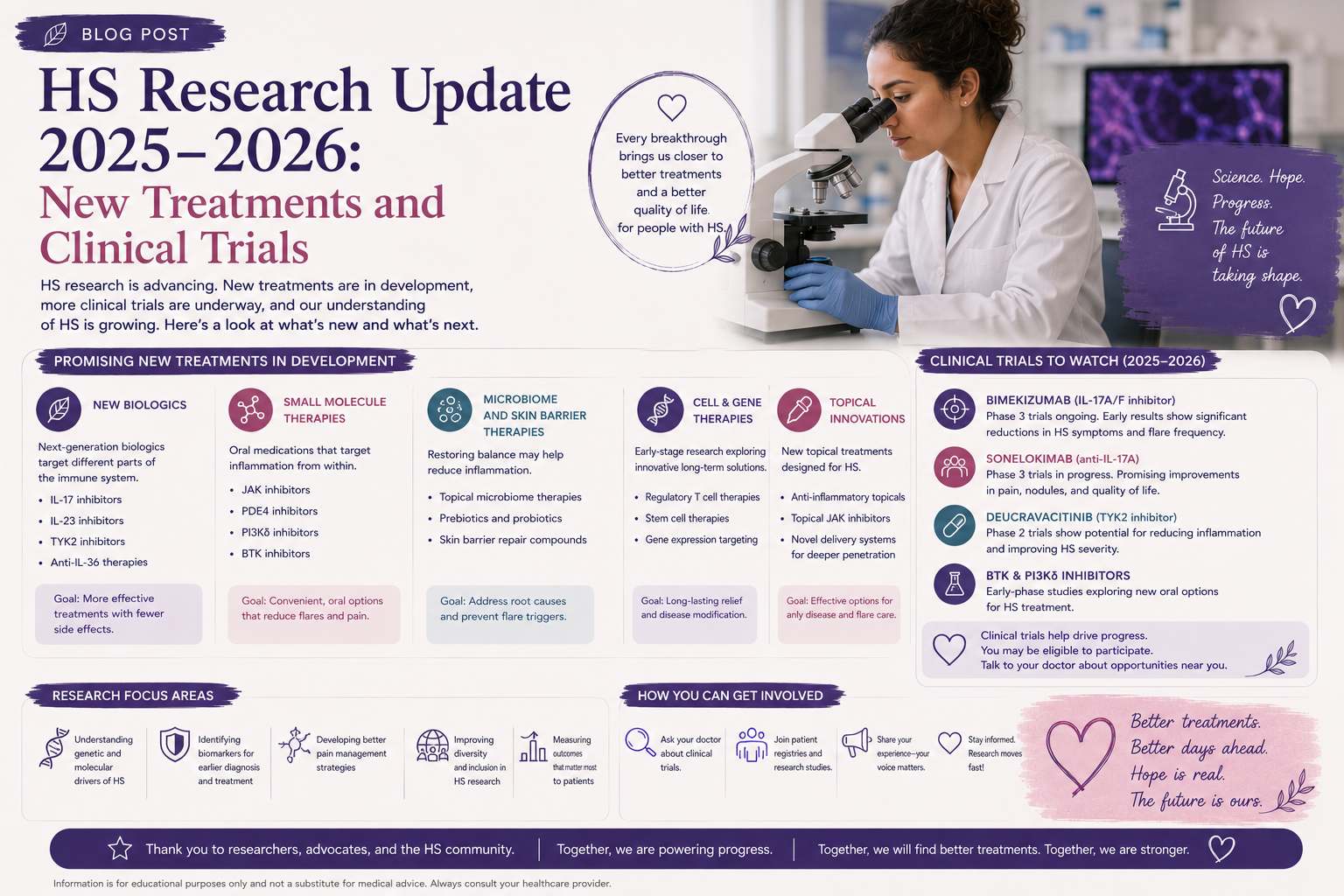
Last reviewed: May 2026 | Community resource — not medical advice. Clinical trial data is preliminary until peer-reviewed and regulatory decisions are final. Always consult a specialist before making treatment decisions.
The treatment landscape for Hidradenitis Suppurativa has changed more dramatically in the past three years than in the previous three decades. For nearly a decade after adalimumab was approved in 2015, patients with moderate-to-severe HS had a single approved biologic option. As of 2026, there are three FDA-approved biologics, an oral JAK inhibitor on the verge of approval, and a pipeline with more promising drugs in late-stage trials than at any point in the history of this disease.
This article is your current overview of where HS treatment stands — what’s approved, what’s coming, what the latest clinical trial data shows, and what it means for patients navigating their options right now.
The Current Approved Landscape (May 2026)
Three medications are currently FDA-approved for moderate-to-severe HS in adults. All three are biologics — injectable monoclonal antibodies that target specific inflammatory pathways.
Adalimumab (Humira and biosimilars) — TNF-α inhibitor
Approved for HS: 2015
The original approved biologic for HS and for many years the only option. Adalimumab targets TNF-α (Tumor Necrosis Factor alpha), one of the key inflammatory signals in HS. Weekly subcutaneous injections after a loading dose.
The PIONEER I and II trials established its efficacy: 42–59% of patients achieved HiSCR50 (at least 50% reduction in inflammatory lesions) at week 12, versus 26–28% on placebo.
Multiple biosimilars are now available at significantly lower cost. As of 2025, seven adalimumab biosimilars have received interchangeable status from the FDA, including Cyltezo, Hadlima, Hyrimoz, and Amjevita. For patients in the US, biosimilar adalimumab can cost as little as $1,300–$1,900 per month at cash price versus $6,900–$11,000 for brand Humira — and with manufacturer assistance programmes, out-of-pocket costs can fall to near zero for eligible patients.
Secukinumab (Cosentyx) — IL-17A inhibitor
Approved for HS: October 2023
Secukinumab targets IL-17A, an interleukin that plays a significant role in HS inflammation. The SUNSHINE and SUNRISE Phase 3 trials demonstrated HiSCR50 rates of approximately 44–47% versus 30–34% on placebo at week 16. Importantly, secukinumab showed efficacy in patients who had previously failed adalimumab, offering a meaningful second-line biologic option with a different mechanism of action. Dosing: weekly loading injections for 5 weeks, then every 4 weeks.
Bimekizumab (Bimzelx) — IL-17A/F dual inhibitor
Approved for HS: 2023/2024 (EU first, then FDA)
Bimekizumab is currently the most clinically exciting approved biologic for HS. Unlike secukinumab, which targets only IL-17A, bimekizumab inhibits both IL-17A and IL-17F — both of which are elevated and pathologically relevant in HS.
The BE HEARD I and II Phase 3 trials enrolled 1,014 patients combined and showed significantly higher response rates than adalimumab in head-to-head context. Initial dosing is every two weeks, transitioning to every four weeks for maintenance.
The Bimekizumab 3-Year Data: A Major Development
The most significant recent data presentation came at the 2026 AAD Annual Meeting in Denver and the EHSF 2026 conference in Malta, where UCB presented three-year extension data from the BE HEARD trials.
The findings are remarkable — and represent some of the most compelling long-term efficacy data ever generated for any HS treatment:
- HiSCR50 rose from approximately 80% at year 1 to over 90% at year 3 — meaning the drug gets more effective over time, not less
- HiSCR90 increased from 42% at year 1 to over 64% at year 3
- 40.1% of patients achieved IHS4-100 (complete clearing of all inflammatory lesions as measured by the severity score) at three years
- 86.1% of patients who entered the extension were free of acute flares at any scheduled visit over three years
- The proportion of patients with severe HS fell from 87.4% at baseline to just 14.7% at three years
- Early treatment yielded better outcomes: among patients with shorter disease duration and Hurley Stage II at baseline, 74.1% achieved HiSCR90 and 62.1% achieved HiSCR100 at year 3
This “response deepening” over time — where efficacy improves rather than plateaus or wanes with continued treatment — is a pattern not seen with adalimumab and represents a fundamentally different disease-modifying trajectory.
The clinical implication is significant: earlier initiation of bimekizumab, before extensive structural damage, appears to enable better long-term outcomes. This reinforces the “window of opportunity” argument for early biologic initiation.
📚 Reference: UCB press release: “UCB announces new BIMZELX data at AAD showing durable symptom control throughout three years in hidradenitis suppurativa.” March 27, 2026. UCB
📚 Reference: “IL-17 Inhibition Is Redefining Long-Term Disease Control in Hidradenitis Suppurativa.” Dermatology Times, May 2026. Dermatology Times
What’s Coming: The Pipeline in Detail
The HS pipeline is the most active it has ever been. Multiple drugs are in Phase 2 and Phase 3 trials, representing several different biological mechanisms. Here is a detailed look at the most advanced candidates.
Povorcitinib — ORAL JAK1 Inhibitor (Incyte)
Status: Phase 3 complete — regulatory submission filed/imminent Mechanism: Selective oral Janus kinase 1 (JAK1) inhibitor — a small molecule, not a biologic
Povorcitinib (INCB54707) is potentially the most transformative development in the HS pipeline because it would be the first oral medication approved for moderate-to-severe HS. All existing approved treatments require subcutaneous injection. An oral tablet once daily would represent a fundamentally different treatment experience for many patients.
Phase 3 STOP-HS trials: The results
Two identical Phase 3 trials — STOP-HS1 (NCT05620823) and STOP-HS2 (NCT05620836) — each enrolled approximately 600 patients with moderate-to-severe HS. Results were reported in stages throughout 2025.
At week 12 (primary endpoint):
- 45 mg dose: 40.2% achieved HiSCR50 vs 29.7% placebo (p=0.024)
- 75 mg dose: achieved statistically significant HiSCR50 vs placebo
By week 24 (interim extension data, presented at EADV 2025 in Paris):
- Nearly 60% of evaluable patients achieved HiSCR50 across both doses
- HiSCR75 achieved in 31–40% of patients
- HiSCR100 achieved in 9–21% of patients
- 62–70% of patients achieved mild or no skin pain at week 24
At 54 weeks (presented at AAD 2026 in Denver):
- 71% achieved HiSCR50
- 57% reached HiSCR75
- 29% achieved HiSCR100 — meaning complete clearance of inflammatory lesions
- Improvements sustained in quality-of-life measures including fatigue and pain
Safety profile: Treatment-emergent adverse events included acne, nasopharyngitis, and upper respiratory tract infections — broadly consistent with JAK inhibitor class effects. Importantly, no major adverse cardiovascular events (MACE) and no deaths were reported in the study period.
Regulatory status: Incyte filed for regulatory approval in Europe in 2025 and anticipated filing in the United States in early 2026. If approved, povorcitinib would be the first JAK inhibitor approved for HS and the first oral systemic therapy for the condition.
What this means for patients: For people who are needle-averse, have difficulty with self-injection, or who simply prefer oral medication, an effective oral option would be genuinely significant. The 54-week data showing 71% HiSCR50 and 29% complete clearance compares favourably with existing approved biologics over similar timeframes.
📚 Reference: Incyte Corporation. STOP-HS Phase 3 data, EADV 2025 and AAD 2026. Managed Healthcare Executive
Sonelokimab — IL-17A/F/albumin Nanobody (MoonLake Immunotherapeutics)
Status: Phase 3 active — VELA-1 and VELA-2 trials Mechanism: Trivalent nanobody targeting IL-17A, IL-17F, and human serum albumin
Sonelokimab is a novel type of molecule — a “nanobody” derived from camelid antibodies. It is smaller than conventional monoclonal antibodies and designed to penetrate tissue more effectively. Like bimekizumab, it targets both IL-17A and IL-17F, but its unique nanobody structure may enable better tissue penetration into HS lesions.
Phase 3 VELA trials results through week 40 (presented EADV 2025 and AAD 2026):
- Approximately 62% achieving HiSCR75 — a notably high bar
- Up to 32% reaching HiSCR100 (complete clearance)
- Up to one-quarter attaining inflammatory remission
- Consistent efficacy across biologic-naive and biologic-experienced populations
These are among the highest response rates reported in Phase 3 HS trials to date, particularly for deeper response metrics like HiSCR75 and HiSCR100.
MoonLake is also running the VELA-TEEN trial in adolescent HS — an important development since HS often begins in adolescence and treatment options for younger patients are currently extremely limited.
Regulatory timeline: The VELA trials are designed to support regulatory submissions. If data continue to hold, sonelokimab could reach regulatory review by 2026–2027.
📚 Reference: MoonLake Immunotherapeutics. VELA Phase 3 week 16 results. MoonLake
Izokibep — Small-Protein IL-17A Inhibitor (ACELYRIN/Affibody)
Status: Phase 3 complete — data published 2025 Mechanism: Small-protein (Affibody) selective IL-17A inhibitor
Izokibep is genuinely novel in its class: it is not a conventional monoclonal antibody but a very small protein molecule (~7 kDa, compared to ~150 kDa for a typical antibody) that selectively inhibits IL-17A with high potency. Its small size is designed to allow better penetration into HS tissue than larger biologics.
Phase 3 results (EADV 2024 and 2025):
- 1 in 3 participants treated with izokibep achieved HiSCR75 at 12 weeks vs 21% on placebo (p<0.05)
- HiSCR90 and HiSCR100 were also significantly higher in the izokibep group
- Notably rapid onset — improvements visible as early as week 2–3
- Consistent efficacy across biologic-naive and biologic-experienced patients
Izokibep is administered as a once-weekly subcutaneous injection at a dose of 160 mg.
The Phase 3 trial results were submitted to ClinicalTrials.gov in October 2025, and regulatory submissions are anticipated.
Orismilast — Oral PDE4 Inhibitor (UNION Therapeutics)
Status: Phase 2/3 Mechanism: Oral phosphodiesterase type 4 (PDE4) inhibitor
Orismilast is an oral small-molecule drug that inhibits PDE4, an enzyme involved in regulating inflammatory signalling. PDE4 inhibition reduces levels of TNF-α, IL-17, IL-23, and other cytokines involved in HS pathogenesis. Notably, PDE4 inhibitors are already approved for other inflammatory conditions (apremilast for psoriasis, roflumilast for chronic obstructive pulmonary disease).
Early phase data for orismilast in HS showed promising anti-inflammatory activity. Phase 3 trials are ongoing. If approved, orismilast would offer a second oral option for HS patients.
Lutikizumab — IL-1α/β dual inhibitor (AbbVie)
Status: Phase 2/3 Mechanism: Dual inhibitor targeting both IL-1α and IL-1β
IL-1 (interleukin-1) is an important inflammatory mediator in HS, and the dual inhibition approach (targeting both α and β forms) may offer broader anti-inflammatory coverage than single-target IL-1 inhibition. AbbVie — the maker of Humira — is developing lutikizumab specifically for HS.
Phase 2 data showed activity, and Phase 3 trials are progressing.
Spesolimab — IL-36 receptor antagonist (Boehringer Ingelheim)
Status: Phase 2 Mechanism: Anti-IL-36 receptor antibody
IL-36 is increasingly recognised as contributing to HS pathogenesis alongside the better-established IL-17 and TNF-α pathways. Spesolimab is already approved for generalised pustular psoriasis, and its existing safety and pharmacological profile makes it a meaningful candidate for HS. Phase 2 trials are ongoing.
Brivekimig — Bispecific antibody (Genmab/AbbVie)
Status: Phase 2 complete Mechanism: Bispecific antibody targeting IL-13 and IL-17A
Phase 2a data for brivekimig in HS (the HS-OBTAIN study) was presented at EADV 2025 in Paris: 67% of patients achieved HiSCR50 compared to 37% on placebo at week 16 — a numerically impressive result for a Phase 2 study, though larger trials are needed to confirm it.
Upadacitinib (Rinvoq) — JAK inhibitor (AbbVie)
Status: Phase 2/3 investigation Mechanism: JAK1 selective inhibitor (already approved for atopic dermatitis, rheumatoid arthritis, psoriatic arthritis)
Upadacitinib (Rinvoq) is already approved and widely used for multiple inflammatory conditions. Its existing safety profile and efficacy track record make it a meaningful candidate for HS. Phase 2/3 investigation for HS is ongoing. If approved for HS, upadacitinib would offer a second oral JAK inhibitor option alongside povorcitinib.
The Shift Toward Remission: A New Treatment Paradigm
One of the most significant conceptual shifts in HS research and clinical practice as of 2026 is the move away from the historical goal of “adequate disease control” toward the aspiration of remission.
For years, the question in HS was: “Is the patient responding?” — defined as 50% reduction in lesions (HiSCR50). This was appropriate in an era when one biologic existed and its efficacy was modest.
As the Dermatology Times analysis of AAD 2026 presentations noted, treatment goals are now “shifting toward HiSCR75/90/100 and remission-like endpoints, paralleling psoriasis paradigms and emphasising early, aggressive suppression to prevent irreversible tissue damage.”
This parallels a shift that occurred in psoriasis treatment 10–15 years ago, when the goal moved from “adequate control” to clear or near-clear skin. In psoriasis, this paradigm shift required better drugs — and led to them. The same dynamic is now driving HS research.
What this means practically:
- HiSCR50 is no longer the ceiling of ambition. Newer agents are achieving HiSCR75, HiSCR90, and even HiSCR100 (complete inflammatory clearance) in meaningful proportions of patients.
- Early treatment matters more than previously appreciated. The bimekizumab 3-year data showing better outcomes in patients with shorter disease duration confirms that treating earlier, while the disease is still in the inflammatory phase and before structural damage, produces fundamentally better results.
- Combination approaches — biologics plus surgery for existing structural damage — are increasingly recognised as the optimal strategy for moderate-to-severe disease.
Understanding Clinical Trial Metrics: A Quick Guide
Reading HS trial reports requires understanding the measurement scales used:
HiSCR50 — The original standard: at least a 50% reduction from baseline in total abscess and inflammatory nodule count, with no increase in abscesses or draining tunnels. This is the most common primary endpoint in HS trials.
HiSCR75 — A 75% reduction. More stringent; considered clinically meaningful in terms of daily function and quality of life.
HiSCR90 — A 90% reduction. Near-complete clearance of active inflammatory lesions.
HiSCR100 — Complete clearance of all inflammatory lesions. The equivalent of “clear” skin in psoriasis trials.
IHS4 — International Hidradenitis Suppurativa Severity Score System. A more granular scoring tool than Hurley staging, measuring nodule, abscess, and tunnel counts. IHS4-75/90/100 follow the same logic as HiSCR.
Inflammatory remission — An emerging endpoint being used in sonelokimab trials, defined as absence of active inflammatory lesions. This goes beyond standard HiSCR to describe a disease-free state.
When evaluating trial results, look at:
- The HiSCR level achieved (50/75/90/100 — higher is better)
- The placebo response rate (often 25–35% in HS trials — the drug’s effect is above this baseline)
- The timeframe (12 weeks vs 24 vs 52 weeks — longer duration confirms durability)
- The patient population (biologic-naive vs experienced — experienced patients are harder to treat)
Finding Clinical Trials: How to Participate
Clinical trials are how new HS treatments are evaluated — and participating in a trial can give access to investigational therapies that aren’t yet commercially available.
How to find HS trials:
- ClinicalTrials.gov — the US government’s registry of clinical trials. Search “hidradenitis suppurativa” with status “Recruiting.” clinicaltrials.gov/search?cond=Hidradenitis+Suppurativa
- EU Clinical Trials Register — for trials in Europe. clinicaltrialsregister.eu
- HS Foundation — regularly publishes information about open trials and connects patients with research opportunities. hs-foundation.org
General eligibility considerations:
Most HS trials require:
- A confirmed HS diagnosis (clinical diagnosis, not a test)
- Moderate-to-severe disease (usually Hurley Stage II or III, or minimum lesion counts)
- A documented history of conventional treatment (usually 3+ months of antibiotic therapy)
- Specific inclusion/exclusion criteria around current medications, BMI, comorbidities, and prior biologic exposure
What participation involves:
Most trials involve regular clinic visits (often monthly) for assessments, blood draws, and study medication administration. Some trials are conducted at specialist HS centres, others at general dermatology practices. All Phase 3 trials use randomisation — you may receive placebo — though most include open-label extensions where all participants eventually receive active treatment.
Compensation and costs:
Trial participation is typically free — the study drug is provided at no cost, and many trials reimburse travel expenses. Discuss logistics with the trial site.
What This Means for Patients Right Now
If you have moderate-to-severe HS and are currently on no biologic, or on a biologic that isn’t working well enough, this research landscape matters for you in concrete ways:
If you’re biologic-naive: Bimekizumab now has 3-year data showing deepening response over time and is arguably the best-supported biologic for HS as of 2026. Adalimumab remains appropriate as a first-line option, particularly given biosimilar cost access. Secukinumab is a strong second biologic. Discuss with your dermatologist which is appropriate for your specific situation.
If you’ve failed or partially responded to one biologic: Switching to a biologic with a different mechanism is evidence-supported. If you’ve been on adalimumab (TNF-α), moving to secukinumab, bimekizumab, or — if available — an IL-17 agent is appropriate. The JAAD 2024 review explicitly advocates for therapeutic drug monitoring to determine whether failure is immunogenic or pharmacokinetic.
If you’re interested in an oral option: Povorcitinib’s NDA was filed in early 2026. It may receive FDA approval in the latter half of 2026. Ask your dermatologist about its status and whether it might be appropriate for you.
If you want access to the most cutting-edge options: Ask your dermatologist about clinical trials. The HS Foundation maintains trial listings, and ClinicalTrials.gov is searchable by location.
The Research Horizon: What We Still Don’t Know
Intellectual honesty requires acknowledging the limits of current knowledge alongside its advances.
No head-to-head trial has compared the approved biologics directly. Comparisons between adalimumab, secukinumab, and bimekizumab are based on cross-trial inference, not direct randomised comparison. A systematic review and network meta-analysis published in 2026 found that several treatments — including sonelokimab, adalimumab, and bimekizumab — achieved higher response rates than placebo, but that “most differences between adalimumab and other targeted treatments lacked statistical significance” due to the absence of direct head-to-head data.
Long-term safety data for newer agents is limited. Bimekizumab now has 3-year data — meaningful but not the 10+ year real-world record that adalimumab carries. Sonelokimab, izokibep, and povorcitinib have even shorter track records.
The optimal sequencing of treatments is unknown. When adalimumab fails, should you try secukinumab or bimekizumab? When bimekizumab fails, what comes next? These questions don’t yet have definitive evidence-based answers.
Predictors of response remain elusive. There is no blood test, genetic marker, or biomarker that reliably predicts which biologic will work for a given patient. Treatment selection is still largely empirical.
The HS Warriors Community
Navigating a rapidly changing treatment landscape is one of the most complex challenges in HS management. Our community includes people who have been on every approved biologic, who have participated in clinical trials, and who are closely following the pipeline. If you’re trying to understand your options, you’re not doing it alone.
👉 Medical treatment discussions 👉 Browse community discussions 👉 Find a specialist dermatologist by region 👉 Join HS Warriors — free and anonymous
This article is for informational purposes only and does not constitute medical advice. Clinical trial data presented here is subject to change as trials progress, data matures, and regulatory decisions are made. Always consult a dermatologist experienced in HS before making treatment decisions.
Sources & Further Reading:
- “IL-17 Inhibition Is Redefining Long-Term Disease Control in HS.” Dermatology Times, May 2026. Dermatology Times
- UCB. “Bimekizumab 3-year data at AAD 2026.” UCB
- Incyte Corporation. STOP-HS Phase 3 data. Managed Healthcare Executive
- Incyte Corporation. “24-Week Phase 3 STOP-HS Data, EADV 2025.” Incyte Investor Relations
- MoonLake Immunotherapeutics. “VELA Phase 3 Week 16 Results.” MoonLake
- “Phase 3 Izokibep Study in HS Produces Promising Results.” Medscape, 2024. Medscape
- Charrow A et al. “Biologics in HS: Progress and new directions.” JAAD, 2024. JAAD
- “Approved HS Treatments and Pipeline Show Similar Efficacy, Safety Without Head-to-Head Trials.” AJMC, 2026. AJMC
- “The HS Therapeutic Pipeline.” Practical Dermatology, March 2026. Practical Dermatology
- ClinicalTrials.gov — HS trials search. clinicaltrials.gov
- HS Foundation. Research and clinical trial resources. hs-foundation.org