
Last reviewed: May 2026 | Community resource — not medical advice. Always discuss treatment options with a dermatologist specializing in HS.
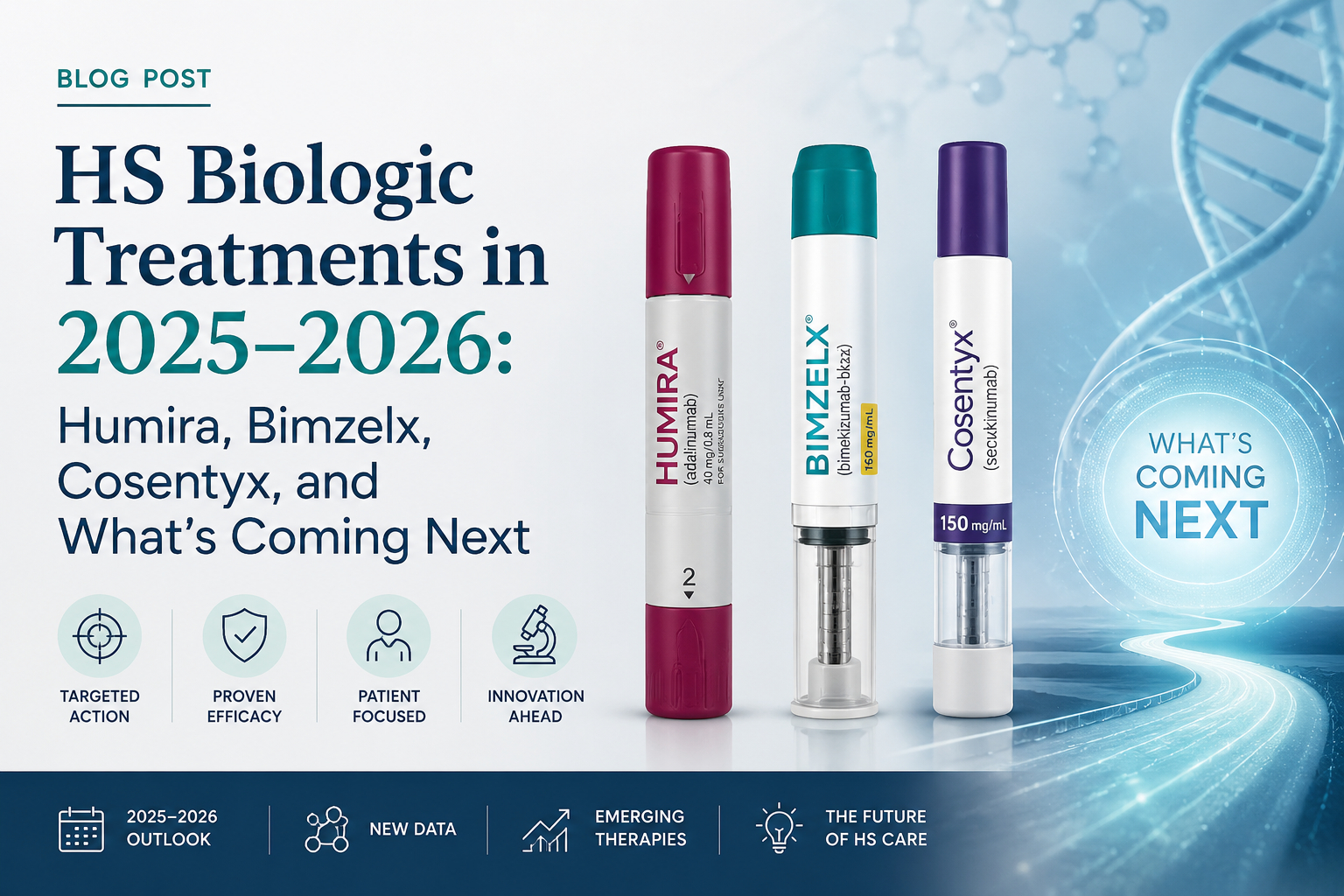
For years, people with moderate-to-severe Hidradenitis Suppurativa had just one FDA-approved biologic option: adalimumab (Humira). That has changed dramatically. As of 2025–2026, there are now multiple approved biologics for HS, several more in late-stage clinical trials, and more options on the horizon than at any point in the disease’s history.
This article explains what biologics are, how they work in HS, what the currently approved options are, and what promising treatments are coming down the pipeline — all based on the latest published research and clinical trial data.
What Is a Biologic, and Why Does HS Need Them?
A biologic medication is a large-molecule drug derived from living cells — unlike traditional small-molecule drugs like antibiotics or steroids. Biologics are designed to target specific proteins or pathways in the immune system that drive disease.
HS is driven by a dysregulated immune response. Research, including a comprehensive 2025 review published in The Lancet by Sabat et al., has established that multiple inflammatory pathways are involved — primarily:
- TNF-α (Tumor Necrosis Factor alpha): a key pro-inflammatory cytokine
- IL-17A and IL-17F: interleukins that drive significant inflammation in HS
- IL-1β: another inflammatory signal involved in HS pathogenesis
- IL-23/IL-12: regulators of immune cell differentiation
Traditional treatments like antibiotics work broadly and only modestly. Biologics target these specific pathways with much greater precision and potency, which is why they can achieve results that antibiotics never could for moderate-to-severe disease.
📚 Reference: Sabat R et al. “Hidradenitis suppurativa.” The Lancet, 2025; 405(10476): 420–438. PubMed
Currently Approved Biologics for HS
1. Adalimumab (Humira) — TNF-α Inhibitor
Approved: FDA approved for moderate-to-severe HS in 2015 — the first biologic ever approved specifically for HS.
How it works: Adalimumab is a TNF-α inhibitor. It binds to and neutralizes TNF-alpha, one of the key drivers of HS inflammation.
How it’s taken: Self-injected subcutaneously (under the skin). Standard HS dosing is 160 mg at week 0, 80 mg at week 2, then 40 mg every week thereafter.
What the evidence says: In the pivotal PIONEER I and PIONEER II trials, approximately 40–58% of patients on adalimumab achieved HiSCR (at least 50% reduction in lesion count) compared to around 27–28% on placebo. These were the trials that led to FDA approval.
Real-world considerations: Adalimumab works well for many patients, particularly those who haven’t been on it before (biologic-naive patients). However, it blocks only TNF-α, and HS involves multiple inflammatory pathways, which may explain why some patients have partial or diminishing responses over time.
Important safety notes: Like all biologics, adalimumab suppresses the immune system. Before starting, you need screening for tuberculosis (TB), hepatitis B, and other infections. You should not receive live vaccines while on adalimumab. Annual flu vaccination is recommended.
Biosimilars: Humira’s patent has expired, and multiple biosimilars are now available (Hadlima, Hyrimoz, Cyltezo, others). These work the same way and are significantly less expensive in countries where biosimilars are covered.
📚 Reference: Kimball AB et al. PIONEER I and II trials. New England Journal of Medicine, 2016.
2. Secukinumab (Cosentyx) — IL-17A Inhibitor
Approved: FDA approved for moderate-to-severe HS in October 2023.
How it works: Secukinumab inhibits IL-17A, an interleukin that plays a significant role in the skin inflammation characteristic of HS. IL-17A is elevated in HS lesions, making it a logical target.
How it’s taken: Subcutaneous injection. Dosing for HS is 300 mg every week for 5 weeks (loading phase), then 300 mg every 4 weeks.
What the evidence says: The SUNSHINE and SUNRISE Phase 3 trials demonstrated that secukinumab achieved HiSCR50 in approximately 44–47% of patients versus 30–34% on placebo. Importantly, it showed efficacy in patients who had previously failed or been intolerant to adalimumab, giving a second-line option that actually works through a different mechanism.
Advantages: Different mechanism from adalimumab means it may work when adalimumab doesn’t, and vice versa. Also approved for psoriasis, psoriatic arthritis, and ankylosing spondylitis — relevant because HS patients often have these conditions.
3. Bimekizumab (Bimzelx) — IL-17A and IL-17F Inhibitor
Approved: FDA approved for HS in 2023/2024. This is currently the most exciting new biologic in the HS space.
How it works: Bimekizumab is unique in that it inhibits both IL-17A and IL-17F — unlike secukinumab, which only targets IL-17A. Both IL-17A and IL-17F contribute to HS inflammation, and blocking both appears to be significantly more effective than blocking just one.
How it’s taken: Subcutaneous injection every 2 weeks initially, then potentially every 4 weeks for maintenance.
What the evidence says — and it’s compelling:
A 2026 pooled analysis published in the Journal of the American Academy of Dermatology by Sayed et al., reviewing data from the BE HEARD I and BE HEARD II Phase 3 trials and their open-label extensions, found:
- Bimekizumab maintained high efficacy over up to 2 years of continuous treatment
- The safety profile remained favorable over this extended period
- Responses were durable — patients who responded tended to stay in response
Separately, a 2025 systematic review and meta-analysis published in PLOS ONE specifically examining bimekizumab for HS found that it significantly outperformed placebo on HiSCR50, and showed strong results also on HiSCR75 (75% reduction in lesion count) — a higher bar that adalimumab typically doesn’t reach.
The real-world significance: more patients achieving deeper, longer-lasting responses than with previous biologics.
📚 Reference: Sayed CJ et al. “Bimekizumab demonstrated a favorable safety profile and high levels of efficacy with up to 2 years of treatment in patients with moderate to severe hidradenitis suppurativa.” JAAD, 2026; 94(3):867-878. PubMed
📚 Reference: “Efficacy and safety of bimekizumab in moderate-to-severe hidradenitis suppurativa: A systematic review and meta-analysis.” PMC, 2025. Read here
Important note on cost and access: Bimekizumab is newer and tends to be expensive. Coverage varies significantly by country and insurance plan. Ask your dermatologist about patient assistance programs if cost is a barrier.
Biologics in Clinical Trials: What’s Coming
The treatment pipeline for HS is more active now than at any point in history. Several drugs are in late-stage (Phase 2/3) trials:
Izokibep — IL-17A Mini-body Inhibitor
Izokibep is a novel, very small IL-17A inhibitor (a “mini-body” rather than a full antibody). Its small size may allow it to penetrate tissue more effectively than larger biologics. Phase 2b trials have been conducted, with Phase 3 underway. The hope is that its unique size offers advantages in tissue penetration for HS lesions.
Guselkumab — IL-23 Inhibitor
Guselkumab targets IL-23, upstream of the IL-17 pathway. Phase 2 trials in HS are ongoing. It is already approved for psoriasis and psoriatic arthritis, so its safety profile is well-characterized.
Spesolimab and Other IL-36 Inhibitors
IL-36 is increasingly recognized as a contributor to HS pathogenesis. Spesolimab (approved for a rare pustular psoriasis variant) and related molecules are being investigated for HS.
JAK Inhibitors (Small Molecules, Not Strictly Biologics)
Janus kinase (JAK) inhibitors are oral small molecules that block multiple inflammatory cytokine signals simultaneously. They are already approved for rheumatoid arthritis, psoriatic arthritis, and inflammatory bowel disease. Several JAK inhibitors are in Phase 2 trials for HS, with early results suggesting activity. These would be oral medications — a significant practical advantage over self-injection for some patients.
How to Know Which Biologic Is Right for You
This is a decision to make with your dermatologist, ideally one who specializes in HS. Factors that typically influence the choice:
Disease severity and previous treatments: Biologics are generally reserved for moderate-to-severe HS (Hurley Stage II or III) that hasn’t responded adequately to antibiotics and other conventional treatments. If you’re biologic-naive, adalimumab or bimekizumab are typically first choices based on availability and evidence.
Previous biologic experience: If you tried adalimumab and it didn’t work or stopped working, you may be switched to a biologic with a different mechanism (secukinumab or bimekizumab). The 2025 narrative review by Garg et al. confirmed that switching between biologics with different targets is a legitimate and evidence-supported strategy.
Comorbidities: If you also have psoriasis, psoriatic arthritis, or inflammatory bowel disease, the biologic choice may be influenced by what treats both conditions.
Pregnancy planning: Adalimumab has the most data on pregnancy safety among HS biologics. Discuss this explicitly if you are pregnant or planning to become pregnant.
Access and insurance: Practically speaking, which biologics are covered in your country or by your insurance plan significantly affects which you can access. Be persistent — prior authorizations can sometimes be obtained with adequate documentation of disease severity and treatment failure.
Understanding the HiSCR Measure Used in Trials
When reading about biologics for HS, you’ll frequently see HiSCR — the Hidradenitis Suppurativa Clinical Response. This is the standard measure used in HS clinical trials to define treatment “response.”
- HiSCR50 = at least 50% reduction in inflammatory lesion count (abscesses + nodules), with no increase in abscesses or draining tunnels
- HiSCR75 = at least 75% reduction — a more stringent and clinically meaningful bar
- HiSCR90 = 90% reduction — near-complete response
When comparing biologics, look at HiSCR rates relative to placebo (since there is always some placebo response in skin disease trials), and look at both HiSCR50 and HiSCR75 to understand the depth of response achievable.
What About Insurance and Getting Access to Biologics?
Getting approved for biologic treatment can be a frustrating process. Most insurance systems require:
- Documentation of moderate-to-severe HS (Hurley Stage II or III, or equivalent)
- Evidence of failure on conventional treatments (typically 3+ months of adequate antibiotic therapy)
- A dermatologist willing to advocate for the approval
Tips from the HS community:
- Ask your dermatologist to document your disease comprehensively in the referral letter, including photos of active lesions, Hurley staging, and a clear list of all previous treatments and their outcomes
- If initially denied, appeal. Many biologic approvals that are initially denied are eventually approved on appeal with more detailed documentation
- Check manufacturer patient assistance programs: AbbVie (Humira/adalimumab), UCB (Bimzelx/bimekizumab), and Novartis (Cosentyx/secukinumab) all have financial assistance programs for patients who qualify
- The HS Foundation has resources on navigating insurance and finding HS specialists
The Bottom Line
The treatment landscape for HS has transformed in the past few years. For people with moderate-to-severe HS who have struggled with inadequate responses to antibiotics and conventional approaches, biologics — particularly the newer ones — offer real hope for meaningful, sustained improvement.
The key steps are: get an accurate Hurley stage assessment from a dermatologist who knows HS, explore whether you’ve failed conventional treatments adequately, discuss the available biologics and their relative evidence, and if cost or access is a barrier, advocate persistently for approval.
You don’t have to settle for suffering. Better options now exist.
👉 Medical treatment discussions in our community 👉 Find a dermatologist by region 👉 Join HS Warriors to share your treatment journey
This article is for informational purposes only. It does not constitute medical advice. Biologic medications carry real risks and require medical supervision. Always consult a qualified dermatologist before starting, stopping, or changing any treatment.
Sources & Further Reading:
- Sayed CJ et al. “Bimekizumab Phase 3 pooled results — 2 years of treatment.” JAAD, 2026. PubMed
- “Efficacy and safety of bimekizumab — systematic review and meta-analysis.” PMC, 2025. Read here
- Garg A et al. “Current Treatments and Future Directions for HS.” Dermatology and Therapy, 2025. PubMed
- Sabat R et al. “Hidradenitis suppurativa.” The Lancet, 2025. PubMed
- Molinelli E et al. “New Insight into the Molecular Pathomechanism and Immunomodulatory Treatments of HS.” MDPI, 2023. PMC
- American Academy of Dermatology. “HS Clinical Guidelines.” AAD.org
- HS Foundation. Resources and provider directory. hs-foundation.org
- ClinicalTrials.gov — ongoing HS trials. clinicaltrials.gov
- National Institutes of Health — PubMed HS biologic research. PubMed