
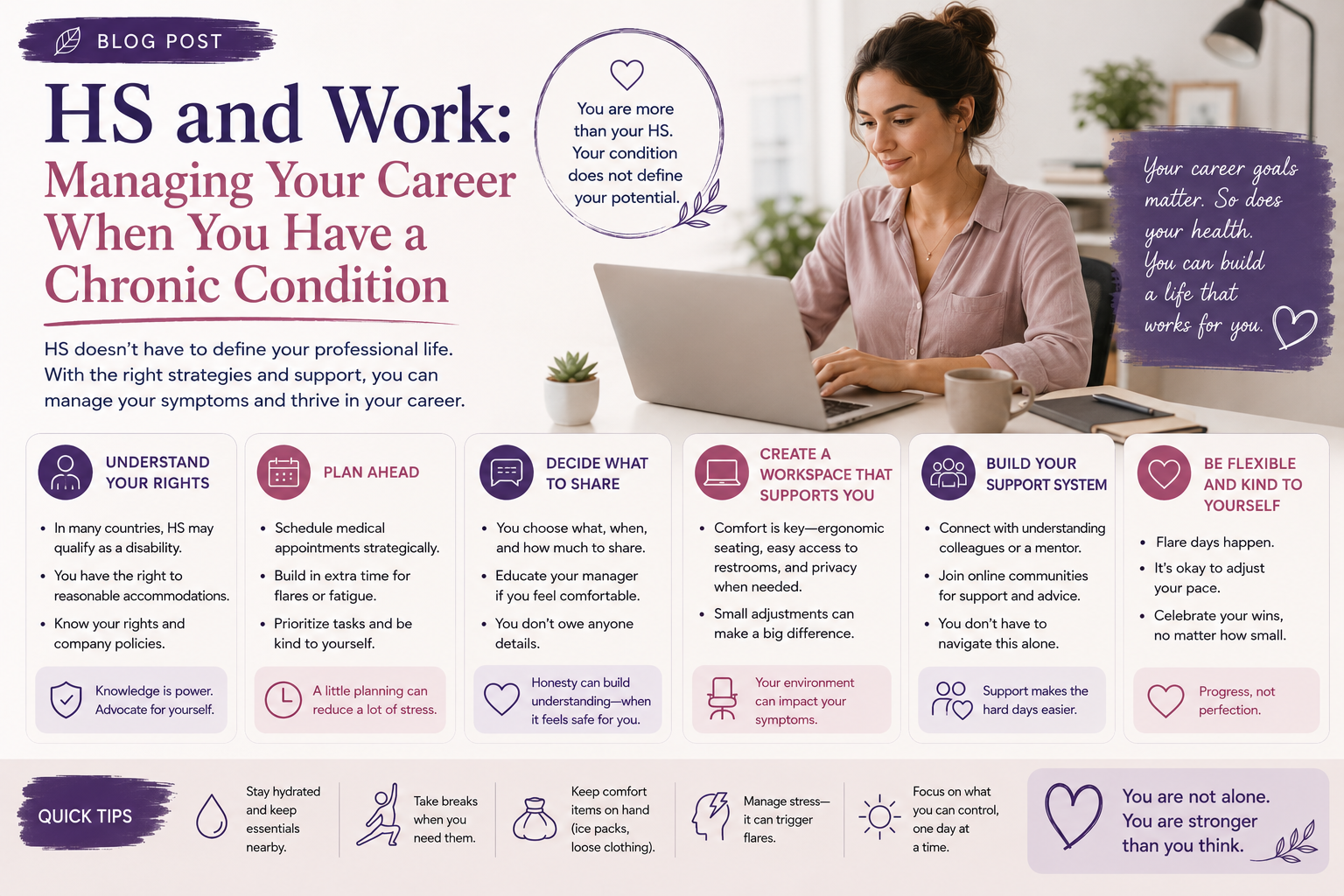
Last reviewed: May 2026 | Community resource — not medical advice. For legal questions about workplace rights or disability benefits, please consult a qualified employment attorney or disability advocate in your country.
For most people, work is not optional. It is how you pay rent, access health insurance, maintain independence, and build a life. When HS interferes with your ability to work — and the research is clear that it does, for a significant proportion of patients — the consequences extend far beyond the office. They reach into your financial security, your sense of self, your relationships, and your future.
This article does not pretend that working with HS is easy. It isn’t. But it also doesn’t accept that your career has to become collateral damage. There are practical strategies, legal protections in multiple countries, workplace accommodations that many employers are required to provide, and — if things have genuinely become unworkable — disability benefits designed for situations exactly like yours.
This guide covers all of it: what the research shows about HS and work, why HS affects careers in specific and sometimes invisible ways, what legal rights you have in the US, UK, and other countries, how to request workplace accommodations, how to talk to your employer, how to document your condition, and when and how to pursue disability benefits.
The Numbers: What Research Shows About HS and Work
The impact of HS on professional life is not just anecdotal. A substantial body of research now quantifies it.
Unemployment and work ability
A large prospective, multicentre German study published in the British Journal of Dermatology in 2023, involving 481 HS patients, found:
- The unemployment rate among HS patients was 12.6% — more than twice the general German population rate
- Work ability was approximately 20% lower than the average employee
- Medical leave because of HS in the past 6 months was reported by 41.4% of patients, averaging 39.3 days of absence
- Only 62.8% of patients were confident they could perform their work in the coming two years
- The estimated annual loss of gross value added due to HS in Germany alone was approximately €12.6 billion
📚 Reference: Schneider-Burrus S et al. “The impact of hidradenitis suppurativa on professional life.” British Journal of Dermatology, 2023. Oxford Academic
Absenteeism and presenteeism
A systematic review and meta-analysis published in Clinical and Experimental Dermatology in 2024, pooling data from 5,187 HS patients across 12 studies, found:
- Absenteeism (time missed from work): 10.17% on average
- Presenteeism (reduced productivity while at work): 31.13%
- Total work productivity impairment: 34.25%
- Total activity impairment (including non-work activities): 42.23%
A global patient survey published in the JAAD in 2024 — the HS Uncovered study covering six countries — found that 52% of diagnosed HS patients reported work productivity loss and 48% reported activity impairment. Patients reported losing a mean of eight hours of work per week due to HS.
📚 Reference: “The impact of hidradenitis suppurativa on work productivity and performance: a systematic review and meta-analysis.” Clinical and Experimental Dermatology, 2024. PubMed
📚 Reference: “Impact of hidradenitis suppurativa on patients’ work and productivity: Results from the HS Uncovered global patient survey.” JAAD, 2024. JAAD
Career trajectory and cumulative impact
A 2025 paper in the Journal of the European Academy of Dermatology and Venereology by Doroudian Tehrani et al. examined HS through the lens of “cumulative life course impairment” — the idea that chronic disease doesn’t just affect today, it shapes the entire arc of a life. The paper found that HS “adversely affects quality of life, education, work, relationships and mental health” and that “the debilitating effects of HS can compound over a patient’s lifetime and have lasting repercussions.”
This framing matters. HS doesn’t just cost you a day here and a promotion there. It can alter the entire trajectory of a career — the jobs you apply for, the hours you can commit, the industries that are accessible, the progression you can sustain.
📚 Reference: Doroudian Tehrani M et al. “Cumulative life course impairment: Evidence for hidradenitis suppurativa.” JEADV, 2025. Wiley
The UAMS data point most worth knowing
Research presented at UAMS (University of Arkansas for Medical Sciences) found that approximately 15% of HS patients are disabled or unable to work due to HS pain. This is a significant minority — and for those in it, understanding their rights and options is essential.
Why HS Affects Work in Specific Ways
Understanding the mechanisms helps you identify which accommodations would actually help, and which conversations to have with your employer.
Physical pain and mobility
HS lesions in the axillae (armpits) can make raising the arms difficult or painful — relevant for any job involving overhead work, lifting, or extended computer use. Lesions in the groin and thighs affect walking, sitting for long periods, and any physical labour. During acute flares, pain can be severe enough to make any physical activity genuinely difficult.
The dressing-change time requirement
Patients managing surgical recovery wounds (after deroofing or wide excision) typically require 30–60 minutes of wound care once or twice daily. This is non-negotiable. It cannot be rushed or skipped. For many patients this happens at home, but flare management during work hours — finding a private bathroom, changing a dressing, managing drainage — is a real and recurring workplace challenge.
Clothing and appearance concerns
Many HS patients wear specific clothing to protect lesions, absorb drainage, or avoid friction — often loose, dark-coloured, or covering garments that may not align with workplace dress codes. This is a legitimate medical necessity, not a preference.
Odour and drainage
During active flares, HS lesions can drain and produce odour. For many patients this is one of the most distressing aspects of the disease in a professional context — the fear of a colleague noticing, of a meeting running long when you can feel a lesion draining, of the anxiety that your condition is visible in ways you cannot control.
Fatigue and the systemic inflammatory burden
HS is a systemic inflammatory disease. Chronic inflammation is physiologically exhausting — not metaphorically, but literally. The same inflammatory cytokines that drive HS lesions also cause fatigue, brain fog, and reduced cognitive endurance. Working through an active flare is not comparable to working when healthy.
Mental health effects
As covered in our HS and Mental Health article, HS is associated with significantly higher rates of depression and anxiety. Both conditions independently impair work performance, attendance, and career advancement. The causal chain often runs in both directions: HS causes depression; depression impairs work; work failure worsens depression.
The unpredictability problem
A predictable chronic condition can often be managed around. HS is unpredictable — a flare can arrive without warning, making it impossible to reliably plan around. This unpredictability makes it difficult to commit to schedules, deadlines, or responsibilities that depend on consistent physical function.
Your Legal Rights: Workplace Protections by Country
United States: The Americans with Disabilities Act (ADA)
In the US, the Americans with Disabilities Act (ADA) and its 2008 amendments (ADAAA) require employers to provide reasonable accommodations to qualified individuals with disabilities, unless doing so would cause undue hardship to the employer.
Does HS qualify under the ADA?
Yes. The ADA defines a disability as a physical or mental impairment that substantially limits one or more major life activities. HS — particularly moderate-to-severe HS — substantially limits activities including walking, standing, sitting, lifting, and caring for oneself. The ADAAA explicitly broadened the definition of disability, and chronic skin conditions causing significant pain and functional limitation clearly qualify.
Important caveat: ADA protections apply to employers with 15 or more employees. Smaller employers are not covered by the ADA, though some states have their own laws with lower thresholds.
What are reasonable accommodations?
Reasonable accommodations are adjustments that enable you to perform the essential functions of your job without removing those essential functions. Examples relevant to HS patients:
- Remote work / work from home — reduces commute stress, allows private wound care, enables rest during high-pain periods
- Flexible start and end times — accommodates wound care appointments, medical visits, and variable pain levels
- More frequent or longer breaks — for wound care or pain management during the workday
- Modified dress code — to accommodate the clothing requirements of HS management
- Access to a private bathroom — for wound care and dressing changes during the workday
- Ergonomic furniture — seating adjustments for patients with active groin or thigh lesions
- Reduced travel requirements — business travel can be genuinely disabling during flares
- Part-time schedules or job restructuring — when full-time work is temporarily impossible
How to request an accommodation (US):
- You do not need to disclose a specific diagnosis to your employer — you are entitled to request an accommodation based on having a medical condition without identifying it by name
- Submit a written request to HR, stating that you have a medical condition and need an accommodation; specify what accommodation you are requesting
- Your employer may ask for documentation from your healthcare provider supporting the need for accommodation — a letter from your dermatologist describing functional limitations (without necessarily disclosing your diagnosis) is appropriate
- Your employer must engage in an “interactive process” — a dialogue about what accommodations are feasible
- If your request is denied, you can file a complaint with the Equal Employment Opportunity Commission (EEOC) at eeoc.gov
📚 Reference: U.S. Equal Employment Opportunity Commission. Disability Discrimination and Reasonable Accommodation. eeoc.gov
United Kingdom: The Equality Act 2010
In the UK, the Equality Act 2010 prohibits discrimination against employees with disabilities and requires employers to make reasonable adjustments. A disability is defined as a physical or mental impairment that has a substantial and long-term adverse effect on the ability to carry out normal day-to-day activities.
HS that causes significant pain, limits mobility, and requires ongoing treatment and wound care clearly meets this definition. The “long-term” criterion is met when the condition has lasted or is expected to last 12 months or more — HS is by definition chronic.
Reasonable adjustments in the UK follow a similar framework to the US ADA: the employer must make adjustments that are proportionate to the cost and disruption they cause versus the benefit they provide to the disabled employee.
The Equality and Human Rights Commission (EHRC) at equalityhumanrights.com provides guidance for UK employees.
For those unable to work due to HS severity, the UK’s Personal Independence Payment (PIP) provides financial support — assessed based on the impact of the condition on daily living and mobility, not the diagnosis itself. Applications are made through the Department for Work and Pensions (DWP) at gov.uk/pip.
Other countries
Canada: The Canadian Human Rights Act and provincial employment standards legislation protect employees with chronic conditions from discrimination. The duty to accommodate applies to all federally regulated employers.
Australia: The Disability Discrimination Act 1992 protects employees with disabilities, including chronic skin conditions, from workplace discrimination and requires reasonable adjustments.
European Union: The EU Employment Equality Directive requires all member states to prohibit disability discrimination in employment and require reasonable accommodation.
The specifics vary by country — if you are outside the US and UK, searching for your country’s equivalent of “disability discrimination law employment” and “reasonable adjustment” will lead you to the relevant legislation.
How to Talk to Your Employer About HS
This is often the hardest part — not the legal framework, but the human conversation. Here is practical guidance for navigating it.
Do you have to disclose your diagnosis?
In most countries, no — you are not legally required to name your condition to request an accommodation. You can say “I have a chronic medical condition” or “I have a skin condition that affects my mobility during flares” without using the words “Hidradenitis Suppurativa.”
However, providing your diagnosis — or at minimum providing a doctor’s letter — typically makes the accommodation process faster and more productive. Vague requests without documentation are easier to deny or delay.
When to disclose
You are not obligated to disclose at the job interview stage. In most countries it is illegal for an employer to ask about medical conditions before making a job offer. However, if your condition affects your ability to perform a specific job requirement, disclosure before or at the time of accepting the offer can prevent problems later.
In an existing role, the right time to disclose is when you need an accommodation — not before, and ideally not during an acute crisis. Starting the conversation proactively, when you are feeling relatively well, gives you control over the narrative.
How to frame the conversation
A practical opening:
“I have a chronic medical condition that is well-managed overall, but can cause episodes of significant pain and mobility limitations. I’d like to discuss some adjustments that would help me maintain my performance consistently — I’ve thought about what would work and I’m hoping we can find a solution that works for both of us.”
This framing:
- Leads with function, not diagnosis
- Acknowledges that you have thought about solutions (not just problems)
- Is collaborative rather than adversarial
- Leaves the door open for a practical conversation rather than triggering a defensive HR response
Getting a letter from your dermatologist
A letter from your dermatologist that describes functional limitations — without necessarily specifying your diagnosis — is one of the most useful tools you have. Ask your dermatologist to include:
- That you have a chronic inflammatory skin condition
- The functional limitations it causes (difficulty sitting for extended periods, restricted arm movement, need for regular wound care during the workday, etc.)
- That these limitations are variable and may fluctuate with disease activity
- A brief statement of what accommodations would help you perform your role
Keep this letter updated — a letter from several years ago during a mild period may not reflect your current situation.
Practical Strategies for Working with HS
Energy management
HS imposes a physiological energy cost — the chronic inflammation, pain, and disrupted sleep that come with active disease mean you are doing everything with a reduced energy budget. Strategies that help:
- Identify your peak hours and schedule the most demanding cognitive work when you have the most energy
- Build recovery time into your schedule — not as a luxury, but as a productivity strategy
- Reduce unnecessary energy expenditure in commuting, social obligations, and other areas when you are in a high-disease-activity period
- Communicate proactively with managers when you are in a flare — “I’m having a high-pain week, here’s what I can and can’t commit to this week” is more professional than silent non-delivery
Wound care at work
If you require wound care during the workday:
- Identify a private bathroom or accessible space before you need it urgently
- Keep a small wound care kit at your desk or in your bag — pre-cut dressings, gentle wipes, a clean change of clothing if needed
- Build buffer time into your schedule around the transition to and from wound care — don’t book meetings immediately before or after
- If it’s relevant to your role, your manager needs to know that you may occasionally need 20–30 minutes of unscheduled private time — this can be framed as a medical need without extensive detail
Career choices and planning
HS affects the type of work that is sustainable long-term for some patients. Honestly assessing what your body can reliably sustain — and building a career around that rather than against it — is not defeat. It is strategy.
Questions worth asking:
- Does my current career path require physical demands that will become increasingly difficult as HS progresses?
- Does my workplace culture support flexible working, which would significantly reduce my day-to-day burden?
- Are there adjacent roles or career paths that offer more flexibility while using my core skills?
- If I became unable to work in my current role for a period, what would my financial and professional contingency look like?
Remote work, freelance or self-employed arrangements, and roles that allow flexible scheduling are not just lifestyle preferences for HS patients — they can be medically important accommodations that the right employer will provide, or that the right role naturally includes.
When Work Is No Longer Possible: Disability Benefits
For a significant minority of HS patients — particularly those with Stage III disease or with multiple severe comorbidities — sustained employment genuinely becomes impossible. This is not a personal failure. It is the medical reality of severe, uncontrolled inflammatory disease, and the benefits systems in most countries exist precisely for this situation.
United States: SSDI and SSI
The Social Security Administration (SSA) offers two main programmes:
Social Security Disability Insurance (SSDI): For workers who have paid into Social Security and become unable to work. Based on your work history and earnings record.
Supplemental Security Income (SSI): Need-based programme for those with limited income and resources who are disabled, regardless of work history. Useful for those whose disease became disabling before they built a substantial work record.
Does HS qualify for Social Security disability?
Yes. HS has historically had its own listing in the SSA “Blue Book” of impairments (Section 8.06). The SSA’s evaluation of skin conditions was updated in October 2023, and HS can now also be evaluated under updated listing criteria for dermatological conditions, or through a Residual Functional Capacity (RFC) assessment if you don’t meet the listing criteria directly.
The RFC assessment evaluates in detail what you can and cannot do — sitting, standing, walking, reaching, lifting — and determines whether these limitations prevent you from performing any work available in the economy.
The critical requirement: Your HS must prevent you from working for at least 12 consecutive months to qualify for SSDI. The SSA does not provide short-term disability.
How to strengthen your application:
- Comprehensive medical records documenting HS severity, Hurley staging, treatment history, and functional limitations
- Documentation of all comorbidities (depression, anxiety, PCOS, metabolic syndrome, etc.) — these strengthen the case
- A detailed functional assessment from your dermatologist or primary care physician
- Records of hospitalisations, surgeries, and emergency visits
- Consider working with a disability attorney — many work on contingency (no fee unless you win) and have significantly higher success rates than self-represented applicants
📚 Reference: HS Connect. “Filing for Disability with HS: A Roadmap to SSDI & SSI Success.” hsconnect.org
United Kingdom: Personal Independence Payment (PIP)
PIP is assessed based on how your condition affects daily living and mobility — specifically, what you can and cannot do reliably, repeatedly, safely, and in a reasonable time. The assessment is done through forms and usually a face-to-face or telephone assessment.
For HS patients, the most relevant assessment areas include:
- Preparing food (if arm movement or standing is limited)
- Washing and bathing (wound care, pain during hygiene routines)
- Dressing and undressing (pain, restricted movement)
- Moving around (walking distance limited by pain in groin/thigh areas)
Keep a diary of how HS affects your daily life before applying — documenting specific limitations on specific days is much more persuasive than general statements.
If initially denied, appeal — the success rate for appeals is significantly higher than for initial applications, particularly with supporting evidence from your medical team.
Employment and Support Allowance (ESA) provides income support for those whose condition prevents them from working. Contact the DWP or Citizens Advice Bureau (citizensadvice.org.uk) for guidance.
Documentation: The Foundation of Every Claim
Whether you are requesting a workplace accommodation, applying for disability benefits, or simply establishing a record for future use, thorough documentation is everything.
Build and maintain a file that includes:
- All medical records relating to HS — diagnosis letters, clinic notes, Hurley staging assessments, treatment records
- Surgical records — procedure notes, recovery documentation
- Prescription history — demonstrating the extent and duration of treatment
- A symptom diary — dates of flares, pain levels (using a 0–10 scale), what activities were affected, time taken off work
- Letters from your dermatologist describing functional limitations
- Records of sick leave — payslips, HR records, GP sick notes
This documentation is the difference between a successful claim and a rejected one. Build it now, while you are managing the condition, not during a crisis when you are too ill to organise paperwork.
The Colleague and Manager Question
How much do your colleagues know? This is personal, and there is no right answer. But a few things are worth considering:
Your manager probably needs to know more than your colleagues. A manager who understands that you have a medical condition affecting your mobility and energy can plan around your needs, communicate with HR on your behalf, and cut you appropriate slack during flares. A manager who has no context will interpret your absences and reduced output as unreliability.
You don’t owe colleagues a medical disclosure. “I have a chronic health condition” is a complete, professional answer to questions about why you sometimes miss work or need accommodations. You are not obligated to name HS or explain it.
Stigma is real, and so is the risk of disclosure. In a perfect world, disclosing a chronic illness would only generate support. In the real world, some workplaces have cultures where illness is perceived as weakness, where accommodations generate resentment, or where disclosed conditions affect how people are treated in evaluations and promotion decisions. You know your workplace. Make disclosure decisions accordingly.
Treatment as Career Protection
This bears stating directly: every conversation about HS treatment is also a conversation about work. Effective treatment that reduces flare frequency and severity directly reduces absenteeism, presenteeism, and the risk of career derailment.
The German study cited above found that “impairment during working hours correlates with disease severity, underlining the socioeconomic importance of early and adequate treatment.” In plain terms: better-controlled HS means better work function.
If your current treatment is not adequately controlling your disease, escalating treatment is not just a health decision — it is a career decision. Every conversation with your dermatologist about whether your treatment is working enough should include the impact on your work life as an explicit consideration.
You Are Not Your Productivity
One more thing, which gets overlooked in practical guides like this: HS is trying to define you by what you cannot do. Your employer, the benefits system, the accommodation framework — all of these necessarily focus on limitations. That is appropriate in that context, but it is not the full picture of who you are.
Your career is not the sum of your medical constraints. It is shaped by your intelligence, creativity, persistence, adaptability, and — frankly — the remarkable capacity that most HS patients develop for managing complexity and pain while continuing to show up. Those qualities are real, they are valuable, and no employer gets to overlook them because of your skin.
The HS Warriors Community
The work and career challenges of HS are some of the most commonly raised topics in our community. If you are navigating a difficult conversation with your employer, considering a disability application, or just trying to figure out how to get through the workday, you are not doing it alone.
👉 Browse community discussions 👉 Mental health and emotional support 👉 Personal stories from the community 👉 Join HS Warriors — free and anonymous
This article provides general information only. Disability benefit eligibility and workplace legal rights vary significantly by country, employer size, and individual circumstances. For advice specific to your situation, consult an employment attorney, disability advocate, or citizens advice service in your country.
Sources & Further Reading:
- Schneider-Burrus S et al. “The impact of hidradenitis suppurativa on professional life.” British Journal of Dermatology, 2023. Oxford Academic | PubMed
- “The impact of HS on work productivity and performance: a systematic review and meta-analysis.” Clinical and Experimental Dermatology, 2024. PubMed
- “Impact of HS on patients’ work and productivity: HS Uncovered global patient survey.” JAAD, 2024. JAAD
- Doroudian Tehrani M et al. “Cumulative life course impairment: Evidence for HS.” JEADV, 2025. Wiley
- “Work Impairment in HS Compared to Psoriasis.” Dermatology Practical & Conceptual, 2024. PMC
- U.S. EEOC. Disability Discrimination and Reasonable Accommodation. eeoc.gov
- ADA.gov. Americans with Disabilities Act of 1990. ada.gov
- Equality and Human Rights Commission (UK). equalityhumanrights.com
- HS Connect. “Filing for Disability with HS: SSDI & SSI Roadmap.” hsconnect.org
- Citizens Advice Bureau (UK). citizensadvice.org.uk
- HS Foundation. Patient resources. hs-foundation.org
- National Institutes of Health — PubMed HS research. pubmed.ncbi.nlm.nih.gov