
Last reviewed: May 2026 | Community resource — not medical advice. If you are struggling with the emotional weight of HS and relationships, please know that support exists — including in this community.
There’s a particular kind of loneliness that comes with HS in relationships. It’s not just physical isolation — it’s the feeling that you are somehow too complicated to be loved. That the drainage, the scarring, the unpredictable pain, the smell during a flare — that all of this means you have forfeited the right to intimacy that other people take for granted.
That feeling is a lie. It’s an understandable lie, produced by a condition that attacks the most intimate parts of your body and your self-image. But it is a lie, and we want to spend this article dismantling it — carefully, honestly, and with the research to back it up.
This guide covers everything: what the science says about HS and sexual health, why HS makes relationships harder in very specific ways, how and when to tell someone you’re dating, how to navigate intimacy during flares, how to support a partner who has HS, and how to hold onto yourself when the disease tries to tell you that love is not for you.
First: The Numbers, Because You Are Not Alone in This
Sexual health and intimacy are among the most commonly reported quality-of-life concerns in HS — and among the least openly discussed. The research, when you look at it, is striking.
A 2024 cross-sectional study published in Dermatology and Therapy by Krajewski et al., drawing on data from 199 patients with HS in Germany, found that 71.8% of women with HS met clinical criteria for sexual dysfunction, and 63.8% of men met clinical criteria for erectile dysfunction. Almost three-quarters of the men with erectile dysfunction in this study had severe erectile dysfunction, not mild.
A separate systematic review published in Dermatologic Therapy in 2025, covering studies up to August 2024, confirmed that sexual dysfunction rates in HS patients range from 42% to 71.8% depending on the study and measurement tool used — consistently and dramatically higher than in the general population.
A Spanish cross-sectional study of 393 patients found sexual dysfunction in 51% of women and erectile dysfunction in 60% of men with HS.
And critically — it’s not just patients. A study by Cuenca-Barrales et al., published in IJERPH, examined both HS patients and their partners. It found that 58.8% of male partners of women with HS also experienced erectile dysfunction — a figure researchers linked to the time of disease evolution and to anxiety about hurting their partner or witnessing their pain.
📚 Reference: Krajewski PK et al. “Profound Sexual Dysfunction Among Patients with Hidradenitis Suppurativa.” Dermatology and Therapy, 2024. PubMed
📚 Reference: Cuenca-Barrales C et al. “Sexual Dysfunction and Quality of Life in HS Patients and Their Partners.” IJERPH, 2022. PMC
📚 Reference: Nigro LC et al. “The Impact of Hidradenitis Suppurativa on Sexual Health: A Systematic Review.” Dermatologic Therapy, 2025. Wiley
These numbers matter not to overwhelm you, but to make clear: if HS has affected your sex life and your relationships, this is one of the most common experiences in this community. There is nothing wrong with you for finding this hard.
Why HS Makes Relationships Harder: The Real Mechanisms
Understanding why HS affects intimacy so profoundly helps separate the disease’s effects from your identity. These are not personal failings — they are documented, measurable consequences of living with this specific condition.
The body’s intimate geography
HS most commonly affects exactly those parts of the body most associated with physical intimacy — the groin, inner thighs, under the arms, buttocks, and perianal region. This is not incidental. These are the areas central to most forms of sexual contact. Active lesions in these areas cause direct physical pain during intimacy, make certain positions or forms of contact impossible, and create the visibility problem — the fear of being seen or touched in those exact places.
The 2025 systematic review on sexual quality of life published in the Journal of Clinical Medicine by Caliezi et al. confirmed that HS patients consistently report reduced sexual desire, avoidance of sexual contact, and decreased sexual satisfaction — with these outcomes linked both to physical pain and to psychological factors including shame and body image distress.
📚 Reference: Caliezi A et al. “Impact of Hidradenitis Suppurativa on Sexual Quality of Life.” JCM, 2025. PMC
Chronic pain reframes the body
When the body is a source of constant pain, it becomes difficult to experience it as also a source of pleasure. Chronic pain — particularly in the erogenous zones — fundamentally changes a person’s relationship with their own body. Many HS patients describe feeling like their body is “not their own” or is “the enemy,” making it hard to inhabit it with pleasure or connection.
Body image and shame
A comprehensive review of the psychosocial effects of HS published in Clinical Therapeutics in 2025 described the relationship between HS and body image in clear terms: negative body image in HS patients leads to “feelings of shame and embarrassment, lack of self-confidence, social isolation, depression, and anxiety.” The review noted that this body image disturbance operates independently of disease severity — patients with Stage I HS can carry profound body shame, not just those with Stage III.
A landmark 2025 multicenter European study published in the International Journal of Dermatology by Marron et al., involving patients across multiple countries, confirmed that HS causes significant stigmatisation that limits not only social interactions but patients’ willingness to seek healthcare — and that this stigma is strongly internalised.
A 2023 multicenter cross-sectional study of 731 HS patients examining internalised stigma found that most patients had accepted negative societal attitudes about their condition as personally true — a phenomenon called “internalised stigma” that directly suppresses confidence in relationships.
📚 Reference: “The Psychosocial Effects of Hidradenitis Suppurativa.” Clinical Therapeutics, 2025. ScienceDirect
📚 Reference: Marron SE et al. “Stigmatization and perceived health status in HS.” International Journal of Dermatology, 2025. Wiley
The unpredictability problem
Even when HS is being managed, flares arrive without warning — derailing plans, cancelling dates, making a body that felt acceptable last week feel unbearable this week. The inability to promise reliability in physical intimacy creates its own anxiety: Will I flare on our anniversary? During our holiday? Right before something we were both looking forward to?
This unpredictability can lead to preemptive withdrawal — avoiding intimacy even when you’re not actively flaring, because you’re anticipating that you might be soon. Over time, this avoidance can create distance that the disease didn’t require.
If You Are Single: Dating with HS
You are not too difficult to love
This is the foundational truth before anything practical. The evidence supports it: most people with HS who enter relationships find partners who are accepting and supportive. The fear of rejection is much more powerful than the reality of rejection, for most people, most of the time.
One of the most consistent findings across patient surveys and community discussions is that people expected rejection and received acceptance. That doesn’t mean rejection never happens — it does, and it hurts. But the worst-case scenario that dominates many HS patients’ imaginations is far less common than the fear suggests.
HS does not define your worth as a partner. Your intelligence, warmth, humour, kindness, ambition, and the particular way you pay attention to people — none of that is diminished by skin disease.
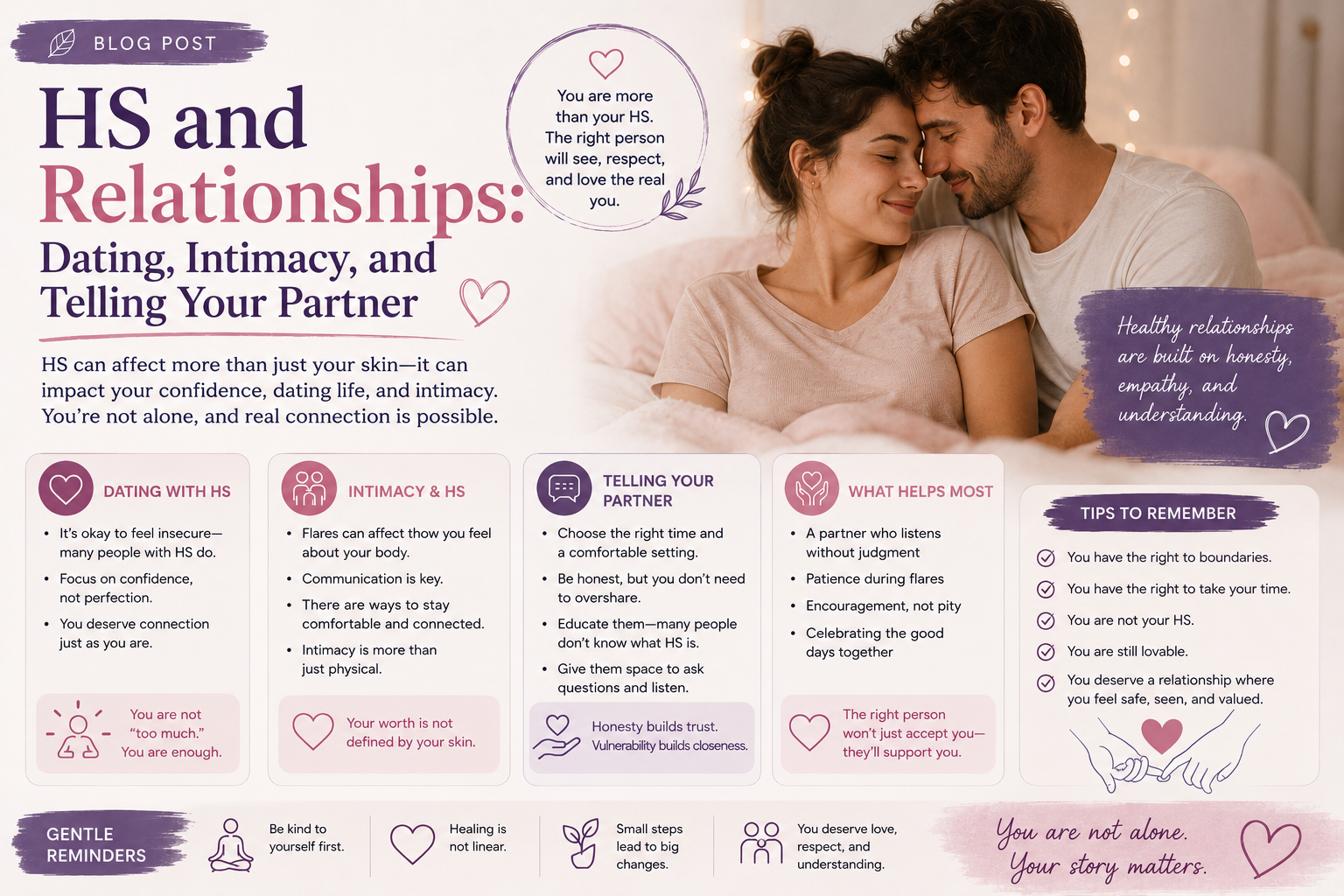
When to tell someone
There is no universal right answer. What the HS community, patient advocates, and the limited research on this topic consistently suggest is:
You are not obligated to disclose on the first date or the first several dates. Early dating is about mutual assessment — seeing whether you enjoy each other’s company, whether there’s chemistry, whether this person is worth investing in emotionally. You don’t owe anyone your medical history before trust has been established.
Disclosure before physical intimacy is important — not just considerate, but practically necessary. Your partner needs to know that what they may see or feel is not an STI, is not contagious, and is not caused by poor hygiene. They also need to understand that some positions or body areas may be off-limits during a flare, and that this is disease-related, not rejection of them.
A staged disclosure approach works well for many people:
- Early on (when it feels right): “I have a chronic skin condition. It’s not contagious and it’s not an STI, but it can affect how I feel and move sometimes. I’ll tell you more as things develop.”
- As things get more serious: A fuller explanation of what HS is, how it affects you specifically, what your flares look like, and what you need from a partner.
- Before physical intimacy: Be clear about active lesions, about areas that are currently off-limits or painful, and about the fact that this may fluctuate.
You don’t need a PowerPoint. You don’t need to show them everything at once. Start with what feels manageable and build from there.
How to have the conversation
Choose the moment carefully. A relaxed conversation over coffee or on a walk tends to work better than a formal “we need to talk” setup, which creates anxiety before you’ve even started. It also shouldn’t happen in the middle of physical intimacy — that creates pressure for both of you.
Lead with what HS is, not with what you fear their reaction will be. “I have a chronic skin condition called Hidradenitis Suppurativa. It causes painful lesions in certain areas of my body — your armpits, groin, thighs. It’s not contagious, not an STI, not related to hygiene. It’s an immune condition. It flares unpredictably and can affect intimacy sometimes.”
Give them time to process. They may have never heard of HS. They may need to ask questions, or they may need a day to think. Allowing space without interpreting their pause as rejection prevents unnecessary hurt.
Send them a resource. Our What Is HS? page exists partly for this purpose — something you can share that explains the condition without requiring you to be present while they read it.
Remember: their reaction is information about them. A person who responds with curiosity, care, and a desire to understand is demonstrating something important about who they are. A person who reacts with disgust or immediate withdrawal is also demonstrating something important. You want to know this early.
“I told my boyfriend about HS on our third date. I just said it plainly — I have this condition, here’s what it is, here’s how it affects me. He listened and asked one question: ‘What can I do to make things easier for you when you’re flaring?’ That was it. That told me everything.” — HS Warriors member
If You Are in a Relationship: Navigating Intimacy with HS
During flares
Active HS flares — particularly in groin, thighs, or buttocks — often make conventional sexual activity impossible or painful. This needs to be communicated, not silently endured.
Be specific about what hurts and what doesn’t. “I’m flaring in my right groin right now, which means X isn’t comfortable, but Y is fine” is more useful than a vague withdrawal that your partner may interpret as emotional distance or rejection of them.
Explore what is comfortable. Physical intimacy is not binary — either full sex or nothing. During flares, many couples find other forms of physical closeness (massage in unaffected areas, non-sexual touch, closeness) that maintain connection without demanding what the body can’t offer right now.
Communicate before, not during. Trying to explain pain or limitations in the middle of intimacy adds pressure and anxiety to an already difficult moment. A brief conversation beforehand — “I’m having a rough day with my skin, here’s what might and might not work” — allows both of you to adjust expectations without anyone feeling rejected or confused in the moment.
Wound care and its intimacy implications
For patients managing open wounds from deroofing or wide excision recovery, the practical realities of wound care can feel deeply incompatible with romantic intimacy. Daily dressings, odour from healing wounds, physical restrictions — all of these are real.
Allowing a partner to help with wound care — even just being present, or handing you dressings — can transform wound care from a shameful private ritual into a shared act of care. Many HS couples describe wound care as unexpectedly intimate once they allowed it to be.
Managing the partner’s experience
HS affects partners too. The research by Cuenca-Barrales et al. confirmed that partners of HS patients experience their own reduction in quality of life and sexual function — linked to witnessing their partner’s pain, anxiety about causing harm, and the general stress of loving someone with a chronic, unpredictable condition.
Partners need:
- Information about what HS is and isn’t — particularly that it is not contagious and not caused by poor hygiene
- Permission to ask questions without feeling like they’re making things worse
- Acknowledgement that this affects them too — partners can feel helpless, worried, or guilty about their own needs, and space to discuss that matters
- Guidance on what actually helps — “when I’m flaring, the most helpful thing is X” is a gift to a partner who wants to help but doesn’t know how
Partners should not:
- Offer unsolicited medical advice or quick-fix solutions
- Express disgust at lesions, drainage, or wound care
- Withdraw from all physical contact because some forms are temporarily not possible
- Make the patient feel that their HS is a burden being tolerated rather than a part of a person being loved
Talking to your partner about your mental health around HS
HS and depression/anxiety are deeply intertwined (see our HS and Mental Health article for the research). If HS is affecting your mood and your self-perception, telling your partner “I’m in a low patch with my mental health and it’s connected to my skin” is as important as telling them about a physical flare.
Partners who understand the mental health dimension of HS — that a bad flare can trigger a spiral of shame, isolation, and depression — can offer support that goes beyond the physical.
Rebuilding Intimacy: What Actually Helps
Therapy, individually and together
Individual therapy — particularly with a therapist who has experience in chronic illness or chronic pain — can help you unpick the shame, body image disturbance, and anticipatory anxiety that HS creates around intimacy. Cognitive Behavioural Therapy (CBT) has specific evidence in chronic illness populations.
Couples therapy, or even a single session with a couples therapist, can give you and your partner a structured space to talk about how HS is affecting your relationship — without the conversation happening in the middle of a crisis.
Sex therapy — a branch of psychotherapy specifically focused on sexual function and intimacy — is worth considering if sexual dysfunction has become a significant and persistent issue. A sex therapist is not primarily a relationship counsellor; they provide specific evidence-based techniques for rebuilding desire, addressing pain, and developing intimacy strategies around physical limitations.
The self-compassion foundation
Research on body image in chronic illness consistently finds that self-compassion — treating yourself with the same kindness you would offer a friend — is the foundation of positive body image, regardless of physical appearance. This is not a platitude. It is a measurable psychological construct with real effects on relationship quality and sexual function.
Some practical self-compassion practices:
- Notice when you are speaking to yourself about your body in ways you would never speak to someone you love
- Separate what your body does (flares, drains, hurts) from what your body is (a complex, living thing that is trying)
- Allow yourself to grieve what HS has taken from your relationship life — the dates you’ve cancelled, the intimacy you’ve avoided, the times you’ve felt too ashamed to be touched — without adding self-blame to grief
Treatment that actually works
This is not separate from the relationship conversation. When HS is better controlled — through effective medication, through surgery where appropriate, through dietary changes that reduce flare frequency — the physical barriers to intimacy reduce. Every conversation about treatment escalation is also, in part, a conversation about your relationship and your quality of life.
If you haven’t yet had the conversation with your dermatologist about how HS is affecting your intimate relationships, have it at your next appointment. It is a legitimate clinical indicator of disease burden and treatment adequacy.
For the Partners Reading This
If you found this article because your partner has HS, here is what they most need you to understand:
They are not their disease. The person you love is not reducible to their skin condition, even when the condition is taking up a lot of space right now.
The shame they carry is heavy and often irrational. They may believe, despite your reassurances, that they are a burden, that you would be better off without them, that no one could genuinely want them in this state. This is HS talking, not truth. Gentle, consistent counter-evidence — showing up, staying, asking how you can help — matters more than any words.
What helps most is often small and consistent. Not dramatic gestures. Learning the name of a medication. Remembering that this week is a high-pain week. Handing them their wound dressing supplies without being asked. Making dinner on the nights when they’ve been in the bathroom for an hour because their dressing change was harder than expected.
They need you to get educated. Read this site. Read our What Is HS? page. Ask your partner’s dermatologist questions at appointments if your partner invites you to attend. Understanding the disease reduces the mystery, and mystery tends to breed anxiety on both sides.
Your needs matter too. Supporting someone with a chronic illness is genuinely hard. You are allowed to find it hard, to feel frustrated or sad or helpless sometimes. Finding your own support — whether through individual therapy, a carers’ support group, or just friends who let you vent — is not selfish. It is sustainable.
A Word on Rejection
It happens. Not everyone will respond to disclosure with understanding and acceptance. Some people will withdraw, and it will hurt, and it will confirm every fear you had about sharing.
When that happens, try — as hard as it is — to hold onto this: the person who can’t be with you because of your HS was not the right person. Not because they are terrible, but because a relationship with someone who cannot navigate your reality with you was never going to be sustainable or safe. Their withdrawal, while painful, protected you both from something that couldn’t have been what you needed.
The right person exists. They may not be the last person, or even the next person. But they exist, and they are not put off by HS — they are interested in the person who carries it with such enormous courage and grace.
The HS Warriors Community
You are not alone in navigating this. Our forums have threads specifically for relationships, dating, and intimacy — spaces where people who truly understand share what has worked, what has hurt, and how they’ve found their way through.
👉 Relationships and intimacy discussions 👉 Personal stories from the community 👉 Mental health and emotional support 👉 Join HS Warriors — free, anonymous, and genuinely understanding
This article is for informational and emotional support purposes. It does not constitute medical or psychological advice. If you are struggling significantly with mental health, relationships, or sexual dysfunction related to HS, please consider speaking with a healthcare provider, therapist, or sex therapist who has experience with chronic illness.
Sources & Further Reading:
- Krajewski PK et al. “Profound Sexual Dysfunction Among Patients with HS.” Dermatology and Therapy, 2024. PubMed | PMC
- Krajewski PK et al. “HS Is Associated with Severe Sexual Impairment.” Dermatology, 2024. PubMed
- Cuenca-Barrales C et al. “Sexual Dysfunction and QoL in HS Patients and Their Partners.” IJERPH, 2022. PMC
- Nigro LC et al. “The Impact of HS on Sexual Health: A Systematic Review.” Dermatologic Therapy, 2025. Wiley
- Caliezi A et al. “Impact of HS on Sexual Quality of Life.” JCM, 2025. PMC
- Marron SE et al. “Stigmatization and perceived health status in HS: multicenter European study.” International Journal of Dermatology, 2025. Wiley
- “The Psychosocial Effects of Hidradenitis Suppurativa.” Clinical Therapeutics, 2025. ScienceDirect
- Sabat R et al. “Hidradenitis suppurativa.” The Lancet, 2025. The Lancet
- HS Connect. “Telling People About HS.” hsconnect.org
- National Institutes of Health — PubMed HS sexual health research. PubMed