
Last reviewed: May 2026 | Community resource — not medical advice. Always consult a dermatologist familiar with HS.
If you’ve recently been diagnosed with Hidradenitis Suppurativa (HS), you’ve probably heard your doctor mention a “stage” or a number between 1 and 3. These are the Hurley Stages — the most widely used system for classifying how severe your HS is. Understanding which stage you’re in can help you have more informed conversations with your care team, understand your treatment options, and connect with others in the community who are navigating similar experiences.
In this guide, we explain what each Hurley Stage means in plain language, what treatments are typically used, and what the research says about living with each stage of HS.
What Is the Hurley Staging System?
The Hurley staging system was created in 1989 by dermatologist H.J. Hurley as a straightforward way to classify the severity of HS based on what can be seen and felt on the skin — no lab tests or imaging required. Despite being over 35 years old, it remains the cornerstone classification system used in clinical practice and research trials worldwide.
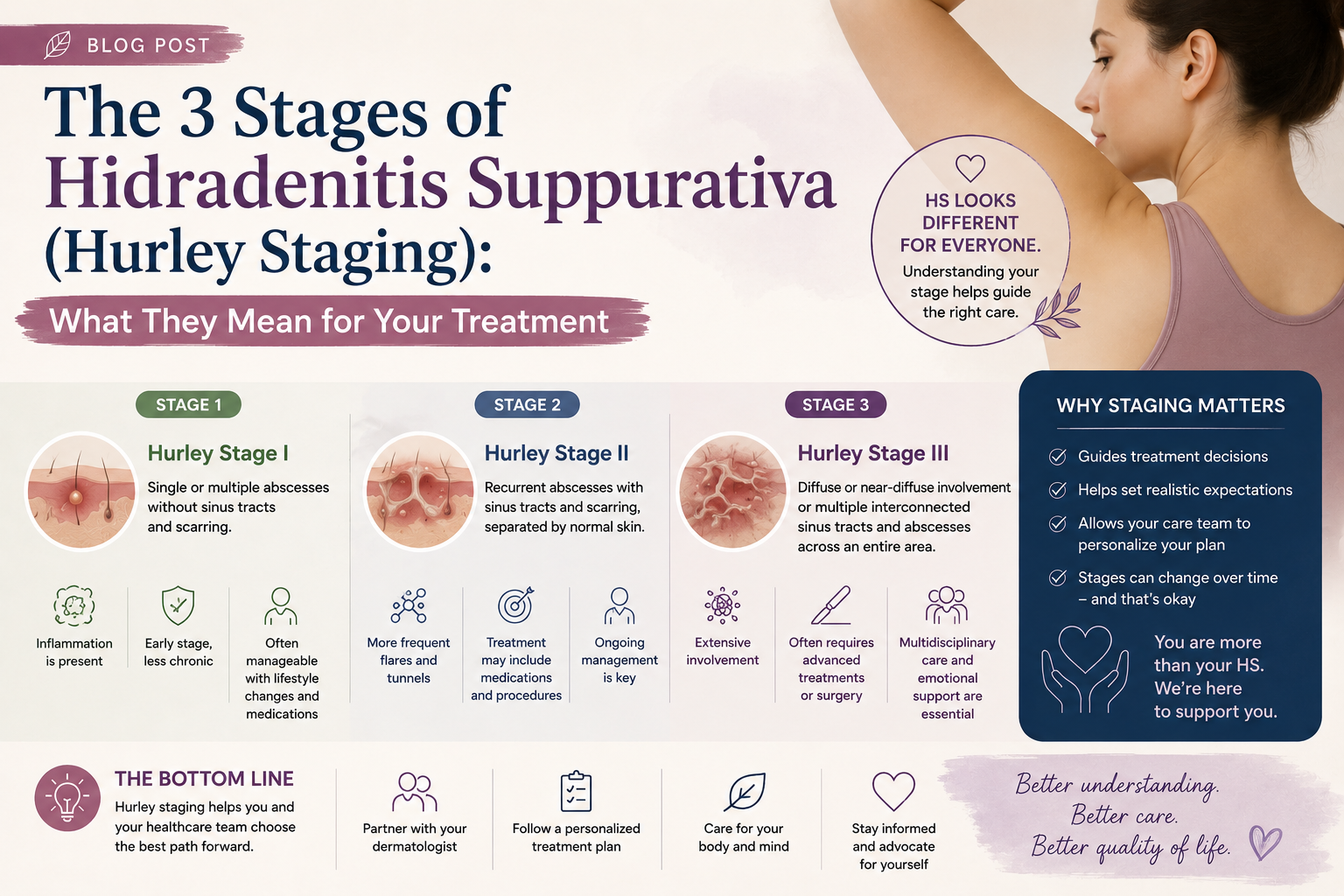
The system has three stages:
- Stage I — Mild
- Stage II — Moderate
- Stage III — Severe
It’s important to know that different parts of your body can be in different stages at the same time. Your armpit might be Stage I while your groin is Stage II. Your doctor assigns an overall stage based on the most severe affected area.
According to data from multiple clinical trials, roughly 68% of HS patients are in Stage I, approximately 28% are in Stage II, and around 4% are in Stage III at any given time. This means the majority of people living with HS have the milder form of the disease — though “mild” for HS is a relative term. Even Stage I HS can cause significant pain and affect daily life.
From our community: “I was told I had ‘mild’ HS and I still couldn’t sleep some nights from the pain. Labels can be misleading — what matters is that it’s real and it hurts.” — HS Warriors member
Hurley Stage I: Mild HS
What it looks like
In Stage I, you may have one or more painful nodules or abscesses — but there are no tunnel formations (sinus tracts) connecting them under the skin, and no scarring (or minimal scarring that you might not yet notice).
The lesions often appear in typical HS areas: underarms, groin, inner thighs, under the breasts, or the buttocks. They can come and go, sometimes healing on their own, sometimes needing to be drained.
How it feels
- Painful lumps under the skin that feel hot and firm
- Lesions that may swell, come to a head, drain, and partially heal
- Recurring in the same spots over weeks or months
- Frustration from doctors misdiagnosing it as boils, folliculitis, or infected cysts
Typical treatments at Stage I
Treatment at this stage usually starts conservatively:
- Topical antibiotics (clindamycin 1% lotion or gel) applied to affected areas — this is one of the most evidence-backed first-line treatments for mild HS according to clinical guidelines from the American Academy of Dermatology (AAD)
- Antiseptic washes such as chlorhexidine or benzoyl peroxide, used in the shower
- Oral antibiotics (tetracyclines like doxycycline or lymecycline) for more persistent cases
- Lifestyle modifications: reducing friction in affected areas, wearing loose clothing, managing weight if relevant, avoiding smoking
- Intralesional corticosteroid injections into individual lesions to reduce acute inflammation quickly
What the research says
A 2025 narrative review published in Dermatology and Therapy by Garg et al. confirmed that for mild HS, topical and systemic antibiotics remain the standard first step, though they note these are off-label uses and “only modestly effective” for patients whose disease progresses. This highlights why early intervention matters — catching HS at Stage I and managing it well can sometimes prevent progression.
📚 Reference: Garg A et al. “Current Treatments and Future Directions for Hidradenitis Suppurativa.” Dermatology and Therapy, 2025. Read on PubMed
Hurley Stage II: Moderate HS
What it looks like
Stage II is defined by recurring abscesses in one or more areas, with the beginning of sinus tract (tunnel) formation under the skin connecting lesions, and visible scarring. Importantly, there is still relatively normal-looking skin between the lesions — they haven’t merged into a continuous affected area yet.
This stage often represents a turning point for many patients. The disease has become more predictable in a bad way — recurring in the same places, leaving marks, and starting to form tunnels that can drain chronically.
How it feels
- Chronic draining sinuses that may smell or stain clothing
- Cycles of flaring, partial healing, and flaring again
- Increasing scarring that changes the texture and appearance of skin
- Pain that may be more constant rather than just during acute flares
- Significant impact on daily activities, work, and relationships
Typical treatments at Stage II
Treatment typically escalates at this stage:
- Combination oral antibiotic therapy: the most evidence-supported regimen is rifampicin + clindamycin for 10–12 weeks
- Hormonal therapy (for women): combined oral contraceptives or anti-androgens like spironolactone or finasteride — especially useful when HS flares are linked to the menstrual cycle
- Zinc gluconate oral supplementation: research, including a randomized trial published in Dermatology, found zinc gluconate reduced lesion counts, making it a useful adjunct with few side effects
- Biologic medications: if antibiotics fail, biologics such as adalimumab (Humira) or the newer secukinumab (Cosentyx) may be considered — these target specific inflammatory pathways driving HS
- Laser treatments: Nd:YAG laser hair removal has shown promise in reducing follicular activity and lesion recurrence in areas like the axilla and groin
- Minor surgical procedures: deroofing (unroofing) of individual tunnels to allow healing from within
What the research says
A landmark comprehensive review of HS published in The Lancet in 2025 by Sabat et al. described HS as a complex immune-mediated condition driven by dysregulation of multiple inflammatory pathways, including TNF-α, IL-17, and IL-1β. This explains why single-target approaches often fail and why combination therapy is so important at Stage II.
📚 Reference: Sabat R et al. “Hidradenitis suppurativa.” The Lancet, 2025; 405(10476): 420–438. Read on PubMed
Hurley Stage III: Severe HS
What it looks like
Stage III is the most severe form of HS. It is characterized by diffuse or near-diffuse involvement of the affected area — meaning multiple interconnected tunnels and abscesses covering a large region, with little to no normal skin visible between lesions.
This stage profoundly affects quality of life and often requires a combination of systemic medications and surgery to manage.
How it feels
- Near-constant pain, drainage, and odor
- Severely restricted movement in affected areas (e.g., difficulty raising arms)
- Significant scarring and skin thickening (fibrosis)
- Major impact on all aspects of life: work, relationships, mental health, sleep
- Feeling misunderstood by healthcare providers and people around you
Typical treatments at Stage III
At this stage, management becomes more aggressive and multidisciplinary:
- Biologic medications are now central to treatment:
- Adalimumab (Humira) — the first and for many years only FDA-approved biologic specifically for moderate-to-severe HS
- Secukinumab (Cosentyx) — an IL-17A inhibitor that received FDA approval for HS in 2023
- Bimekizumab (Bimzelx) — an IL-17A/F inhibitor approved in 2023/2024 that has shown impressive results in Phase 3 trials
- Surgical intervention: wide local excision — removing the entire affected skin area — is often the only way to achieve long-term remission in Stage III. Recurrence rates vary depending on the technique and how wide the margins are.
- Carbon dioxide (CO₂) laser surgery is an alternative that some surgeons prefer for certain body locations, as it allows more precise tissue removal with potentially better healing.
- Combination biologic + surgical approach is often the most effective strategy for severe disease.
What the research says on Bimekizumab (the newest treatment)
One of the most exciting recent developments is bimekizumab (Bimzelx). A 2026 pooled analysis published in the Journal of the American Academy of Dermatology by Sayed et al. reviewed two Phase 3 trials and their open-label extensions, finding that bimekizumab maintained favorable safety and high efficacy over up to 2 years of treatment in patients with moderate-to-severe HS.
A 2025 systematic review and meta-analysis published in PLOS ONE found that bimekizumab significantly outperformed placebo on the HiSCR50 measure (at least 50% reduction in inflammatory lesion count), making it one of the most effective biologics currently available for HS.
📚 Reference: Sayed CJ et al. “Bimekizumab demonstrated a favorable safety profile and high levels of efficacy with up to 2 years of treatment.” JAAD, 2026; 94(3):867-878. Read on PubMed
Limitations of the Hurley System: What It Doesn’t Capture
The Hurley system is useful, but it has real limitations that every HS patient should understand:
- It doesn’t measure pain — a Stage I patient can be in excruciating pain, while some Stage II patients have learned to manage
- It doesn’t capture flare frequency — how often you flare is not reflected in the staging
- It doesn’t account for quality of life — two patients at the same Hurley stage can have vastly different daily experiences
- It doesn’t reflect emotional impact — the psychological burden of HS often bears no direct relationship to the physical stage
This is why researchers and clinicians also use additional tools like:
- HiSCR (HS Clinical Response) — measures response to treatment in trials
- IHS4 (International HS Severity Score System) — a newer, more granular scoring tool
- DLQI (Dermatology Life Quality Index) — captures how HS affects daily life
When you visit a dermatologist, it’s entirely reasonable to ask: “What tools are you using to track my HS severity over time?”
Can HS Progress Between Stages — or Improve?
Yes to both. HS can progress from Stage I to Stage II or III over months or years, especially if untreated or undertreated. However, with appropriate medical management and lifestyle changes, it’s also possible to experience significant improvement — even if a complete cure remains out of reach with current treatments.
Factors that may influence progression:
- Delay in diagnosis: the average person with HS sees multiple doctors over 7–10 years before getting a correct diagnosis. Earlier diagnosis means earlier treatment.
- Smoking: strongly associated with more severe HS and poorer treatment response. Quitting smoking is one of the most impactful things a patient can do.
- Obesity: excess weight increases friction and inflammation in HS-prone areas. Weight loss has been shown to reduce disease severity.
- Hormonal factors: HS often worsens around puberty, menstruation, and pregnancy — and may improve after menopause in some women.
Talking to Your Doctor About Your Stage
If you don’t know your current Hurley stage, it’s worth asking directly at your next appointment. You might say: “What Hurley stage am I currently in, and how does that affect which treatments we should try next?”
If you feel your current treatment isn’t working, the evidence supports escalating therapy rather than staying on the same ineffective treatment for months. Many patients benefit from seeing a dermatologist who specializes specifically in HS — the HS Foundation maintains a directory of HS-experienced physicians.
The HS Warriors Community Is Here
No matter which stage you’re in, you’re not navigating this alone. In our forums, you’ll find thousands of people at every stage sharing what’s worked, what hasn’t, and how to keep going when HS feels overwhelming.
👉 Browse HS treatment discussions 👉 Share your HS story 👉 Find a dermatologist by region
This article is for informational purposes only and does not constitute medical advice. For diagnosis and treatment decisions, always consult a qualified healthcare provider. The HS Warriors community comprises patients and caregivers sharing experiences, not medical professionals.
Sources & Further Reading:
- Garg A et al. “Current Treatments and Future Directions for Hidradenitis Suppurativa.” Dermatology and Therapy, 2025. PubMed
- Sayed CJ et al. “Bimekizumab Phase 3 pooled results.” JAAD, 2026. PubMed
- Sabat R et al. “Hidradenitis suppurativa.” The Lancet, 2025. PubMed
- American Academy of Dermatology. “HS Clinical Guidelines.” AAD.org
- HS Foundation. “Find an HS Provider.” hs-foundation.org
- National Institutes of Health — PubMed HS research. pubmed.ncbi.nlm.nih.gov