
Last reviewed: May 2026 | Community resource — not medical advice. Always consult a healthcare provider before making major dietary changes.
Can what you eat affect your Hidradenitis Suppurativa? The honest answer is: yes, for many people it does — though the science is still catching up to what patients have been reporting for years.
If you’ve been living with HS for any length of time, you’ve likely noticed that certain foods seem to trigger flares while others leave you feeling calmer. That experience is valid, and it’s increasingly backed by research. This guide breaks down everything currently known about diet and HS — the foods that may help, the foods that may hurt, the supplements worth considering, and the diets that have shown the most promise.
This isn’t about a miracle cure. It’s about giving you evidence-based tools to work with — alongside, not instead of, medical treatment.
Why Does Diet Matter in HS?
HS is fundamentally an inflammatory disease. The painful nodules, abscesses, and sinus tracts that define HS are driven by an overactive immune response — inflammation that gets triggered and then can’t be properly turned off.
Everything that raises systemic inflammation in your body has the potential to worsen HS. Everything that lowers inflammation may help calm it. Food is one of the most powerful levers you have to influence systemic inflammation, and it’s one you control every single day.
Beyond inflammation, diet intersects with HS through several other mechanisms:
- Hormonal effects: Insulin spikes caused by high-glycemic foods stimulate androgen production, which can worsen HS. Dairy products contain natural hormones and growth factors that may have similar effects.
- Gut microbiome: Emerging research suggests the gut microbiome plays a role in immune regulation, and people with HS may have distinct microbiome patterns. Diet is the primary driver of microbiome composition.
- Body weight: Excess weight increases friction in HS-prone areas, elevates systemic inflammation, and is associated with more severe disease. Diet directly affects body weight.
- Specific nutrients: Deficiencies in zinc and vitamin D — both common in HS patients — have been linked to worse outcomes. Dietary choices affect nutrient levels.
A 2025 review published in PubMed specifically examining the relationship between diet and HS concluded that “pro-inflammatory diets such as the Western diet, leucine-rich diets, and brewer’s yeast were associated with HS exacerbation through mTOR activation and hormonal dysregulation,” while anti-inflammatory dietary approaches showed meaningful benefit.
📚 Reference: “Nourishing the Skin: A Review of Diet’s Role in Hidradenitis Suppurativa.” PubMed, 2025. Read here
Foods to Avoid with HS
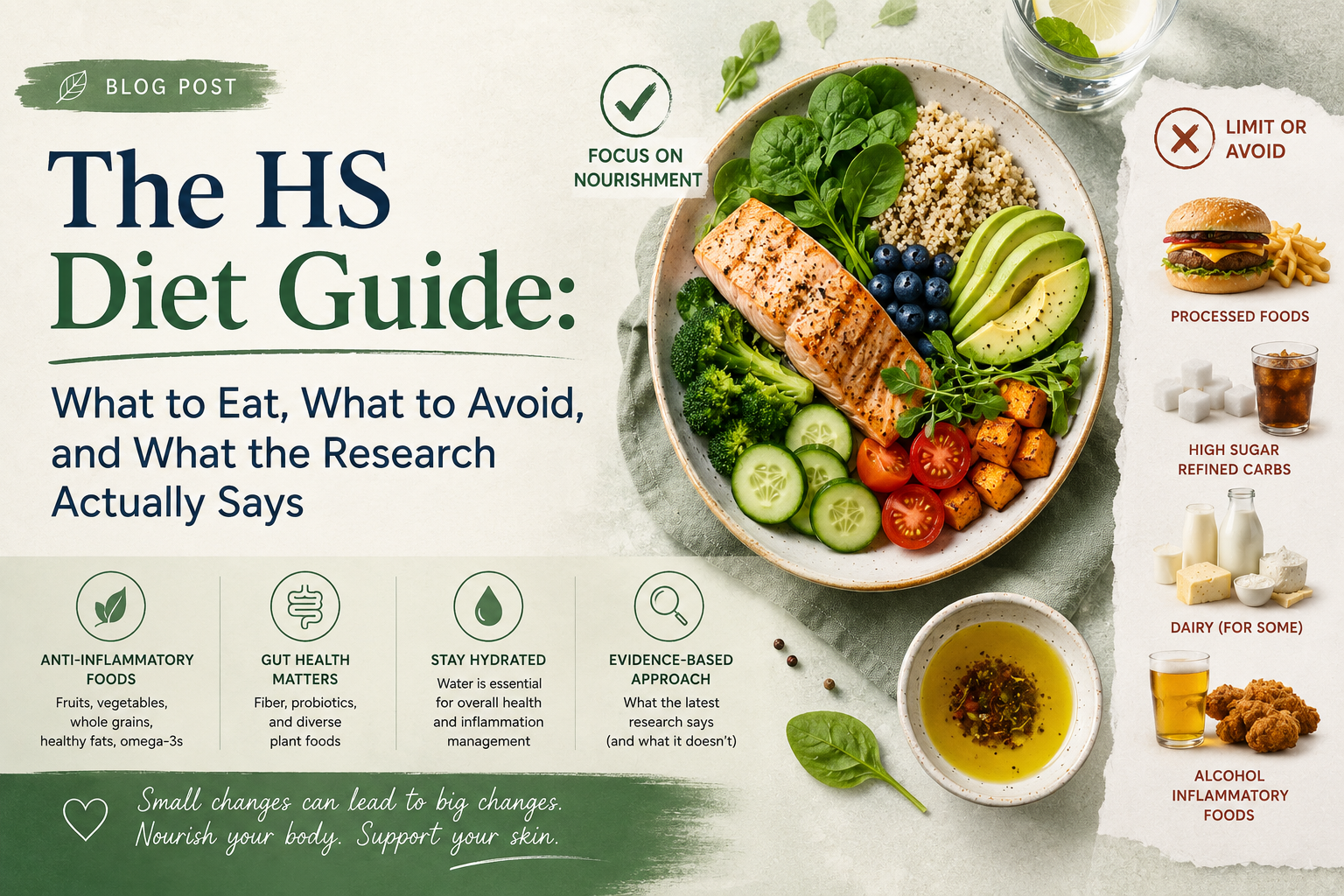
These are the food categories with the most evidence for triggering or worsening HS flares. Note that not every person reacts to every category — HS is highly individual. An elimination approach (removing one thing at a time and observing) is often more useful than cutting out everything at once.
1. Brewer’s Yeast
This is perhaps the most specific and well-documented dietary trigger for HS. Brewer’s yeast (Saccharomyces cerevisiae) is found in:
- Beer and many other alcoholic drinks
- Bread, pizza dough, and baked goods made with yeast
- Yeast extracts (Marmite, Vegemite)
- Some nutritional supplements
Several case series and small trials have found that eliminating brewer’s yeast from the diet led to significant improvement in HS severity in a subset of patients. The mechanism isn’t fully understood, but it may involve an immune reaction to yeast antigens.
What the community says: Many HS Warriors members report this as their single most impactful dietary change. Even if you’re not certain yeast is a trigger for you, a 4–6 week elimination is worth trying.
2. Dairy Products
Dairy is another frequently reported trigger. Milk, cheese, yogurt, and butter all contain:
- Natural hormones (estrogens, progesterone) that may worsen hormonal HS
- Growth factors including IGF-1 (insulin-like growth factor 1), which can activate the mTOR pathway implicated in HS pathogenesis
- Casein and whey proteins that stimulate insulin release
A dairy-free diet was specifically highlighted in the 2025 dietary review referenced above as one of the approaches showing “promising results in mitigating HS flares.”
Practical note: Some people find that cutting out all dairy is too difficult and choose to start with eliminating high-casein dairy (cow’s milk, most hard cheeses) while potentially tolerating goat or sheep dairy better. Listen to your body.
3. High-Glycemic Foods (Sugar and Refined Carbs)
Foods that spike blood sugar rapidly — white bread, white rice, pasta, sugary drinks, candy, pastries, processed snacks — cause elevated insulin levels. High insulin stimulates androgen production and activates inflammatory pathways.
Research published in the International Journal of Dermatology in 2024 confirmed that “foods with a high glycemic index and dairy could worsen HS symptoms, conceivably through mechanisms linked to insulin resistance and inflammation.”
📚 Reference: Vural et al. “Evaluating dietary considerations in hidradenitis suppurativa.” International Journal of Dermatology, 2024. Read on Wiley
4. Processed and Red Meats
Heavily processed meats (hot dogs, sausages, deli meats) and fatty red meats contain advanced glycation end products (AGEs), saturated fats, and compounds that promote oxidative stress and inflammation. These are best minimized rather than eliminated entirely for most people.
5. Alcohol
Beyond the brewer’s yeast content of beer, alcohol in general promotes systemic inflammation, disrupts sleep (which affects immune function), and is often high in sugar. Many HS patients find that alcohol consumption reliably triggers flares within 24–48 hours.
Foods That May Help HS
The Mediterranean Diet: The Best-Studied Approach
The Mediterranean diet is consistently the most studied and supported dietary pattern for HS. It emphasizes:
- Vegetables and fruits (especially leafy greens, tomatoes, berries, and citrus)
- Legumes (lentils, chickpeas, beans)
- Whole grains (oats, brown rice, quinoa, whole wheat)
- Fatty fish (salmon, mackerel, sardines, trout — at least 2–3 times per week)
- Extra virgin olive oil as the primary fat
- Nuts and seeds (especially walnuts, almonds, flaxseeds)
- Moderate poultry and eggs
- Minimal red meat, dairy, and processed foods
A study published in BMC Dermatology and multiple reviews have found that patients who follow the Mediterranean diet more closely tend to have less severe HS and better quality of life scores. A 2019 study specifically showed the diet could improve HS disease severity — and a 2025 cross-sectional study of HS patients in Spain reinforced these findings, noting that Mediterranean dietary adherence was associated with reduced disease burden.
📚 Reference: “Potential Benefits of the Mediterranean Diet and Physical Activity in Patients with Hidradenitis Suppurativa.” PMC, 2022. Read here
Omega-3 Fatty Acids
Omega-3s (EPA and DHA) are potent anti-inflammatory compounds. The best food sources are:
- Fatty fish: salmon, mackerel, herring, sardines, trout
- Flaxseeds and chia seeds (ALA form, less potent but still helpful)
- Walnuts
The Cleveland Clinic explicitly recommends aiming for oily fish at least twice a week for HS patients. If fish isn’t accessible or tolerable, an omega-3 supplement (fish oil or algae-based for vegans) is a reasonable alternative.
Zinc-Rich Foods
Zinc deficiency is common in people with HS and is associated with more severe disease. Foods high in zinc include:
- Oysters (the highest food source)
- Red meat and poultry
- Pumpkin seeds
- Chickpeas and lentils
- Hemp seeds
- Cashews
Zinc has both anti-inflammatory and immune-modulating effects, and supplementation (zinc gluconate, typically 30–90 mg/day) has shown benefit in small clinical trials. Talk to your doctor before supplementing, as high doses can cause side effects.
Vitamin D Sources
Multiple studies have found that HS patients are more likely to be deficient in vitamin D, and that lower vitamin D levels correlate with more severe disease. While the sun is the best source of vitamin D, dietary sources include:
- Fatty fish
- Egg yolks
- Fortified foods (milk alternatives, cereals)
- Mushrooms exposed to UV light
Most HS patients would benefit from having their vitamin D level checked (25-OH vitamin D blood test) and supplementing if deficient. Target levels of 40–60 ng/mL are generally recommended.
Anti-Inflammatory Vegetables
In particular:
- Leafy greens (spinach, kale, arugula, chard): rich in magnesium, folate, and antioxidants
- Cruciferous vegetables (broccoli, cauliflower, Brussels sprouts): contain sulforaphane, a compound that helps regulate NF-kB inflammatory pathways
- Turmeric: curcumin, the active compound in turmeric, has documented anti-inflammatory effects. It’s best absorbed with black pepper and fat. Add to curries, golden milk, or take as a supplement.
- Ginger: similarly anti-inflammatory; easy to add to teas, smoothies, or cooking
- Berries: blueberries, raspberries, and blackberries are high in anthocyanins, which reduce inflammatory markers
Special Diets: What We Know
Very Low-Calorie Ketogenic Diet (VLCKD)
The 2025 dietary review found that a very low-calorie ketogenic diet showed “promising results” for HS. The theory is that ketosis reduces insulin levels and inflammation through multiple mechanisms. However, this is a very restrictive approach, hard to sustain long-term, and requires medical supervision. It may be worth discussing with your doctor if other dietary changes haven’t helped enough.
Autoimmune Protocol (AIP) Diet
The AIP diet eliminates grains, legumes, dairy, eggs, nuts, seeds, nightshades, and alcohol for a period, then reintroduces them one at a time to identify triggers. It’s more restrictive than Mediterranean and there’s limited HS-specific research, but many patients report significant improvement. Because it eliminates most of the common HS dietary triggers simultaneously, some people find it useful to identify their specific sensitivities.
Intermittent Fasting
The 2024 review by Vural et al. noted that intermittent fasting “merits further investigation” for HS. The potential benefits include reduced insulin levels and improved metabolic health. It’s not a magic solution, but some HS patients report it helps them manage weight and reduce flare frequency.
Practical Tips for Changing Your HS Diet
Start with one change, not ten. The most sustainable approach is to eliminate one potential trigger at a time for 4–6 weeks, track your symptoms honestly, and then decide whether to continue. Trying to overhaul your entire diet at once leads to burnout and makes it impossible to identify which change is actually helping.
Keep a food and symptom diary. This is one of the most powerful tools available to HS patients. Note what you eat and when, and record when flares start. Patterns often emerge within 2–3 months that would be invisible otherwise.
Work with a registered dietitian (RD) if possible. An RD familiar with inflammatory skin conditions can help you design a nutrition plan that is anti-inflammatory but also nutritionally complete and sustainable. Ask your dermatologist for a referral.
Don’t expect overnight results. Dietary changes typically take 4–12 weeks to show meaningful effect on HS symptoms. Inflammation in chronic conditions changes slowly. Give any dietary modification at least 6 weeks before evaluating.
Diet is an adjunct, not a replacement. Diet changes can meaningfully reduce flare frequency and severity for many patients. They are unlikely to replace medical treatment in moderate-to-severe HS. The best outcomes typically come from combining dietary improvements with appropriate medical care.
What Doesn’t Have Enough Evidence Yet
To be honest about the limits of the science:
- Gluten-free diets: There’s no strong evidence for benefit in HS unless you have confirmed celiac disease or gluten sensitivity. However, gluten-free diets often eliminate many refined carbs and processed foods, which may explain anecdotal improvements.
- Nightshade elimination: Some patients report improvement from eliminating nightshades (tomatoes, peppers, eggplant, potatoes). The research doesn’t support this for HS specifically, but personal experimentation is reasonable.
- Specific supplements: Beyond zinc and vitamin D, most other supplements (turmeric, omega-3s, probiotics) have theoretical benefits but limited HS-specific trial data. Promising but not yet proven.
Share Your Experience in the Community
What dietary changes have made the biggest difference for your HS? Have you tried eliminating brewer’s yeast, going dairy-free, or following the Mediterranean diet? Share your experience — your real-world knowledge could be invaluable to someone newly diagnosed.
👉 Join the HS diet discussion forum 👉 Browse all community topics 👉 Register to share your story
This article is for informational purposes only and does not constitute medical advice. Always consult a qualified healthcare provider or registered dietitian before making significant dietary changes, especially if you are on medications.
Sources & Further Reading:
- “Nourishing the Skin: A Review of Diet’s Role in Hidradenitis Suppurativa.” PubMed, 2025. Read here
- Vural et al. “Evaluating dietary considerations in hidradenitis suppurativa.” International Journal of Dermatology, 2024. Read on Wiley
- “Potential Benefits of the Mediterranean Diet and Physical Activity in Patients with HS.” PMC, 2022. Read here
- “Hidradenitis Suppurativa and Dietary Patterns.” Research Square, 2026. Read here
- Cleveland Clinic. “Hidradenitis Suppurativa Diet.” Read here
- Healthline. “HS Diet: Foods to Avoid, Eat, and More.” Read here
- National Institutes of Health — PubMed HS research. pubmed.ncbi.nlm.nih.gov